Sunday, March 8, 2009

Does Love Supplant Justice?

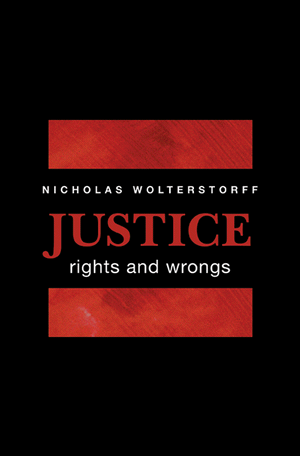
For my birthday I took the liberty of ordering two books that have been bouncing around theology blogs for the past month or so. I started Justice: Rights and Wrongs by Nicholas Wolterstorff, which seeks to ground, to the exclusion of any other narratives, the idea of inherent human rights within theism. I'm struggling through it for several reasons, the main being that I'm not adept enough in his fields of interest to know whether he is pulling a narrative over my head or not. This is not a case of the unreliable narrator but a case of the unreliable reader. I have little knowledge with which to judge his claims so I have to read suspiciously lest I be convinced of ideas that I don't want to, or that I'm not supposed to be convinced of. Ahh the life of a lay-anything feels so unrewarding at times.

(For critics who can offer a more authoritative analysis of the book, check out The Immanent Frame blog)

Regardless, I carry on.

The title question arises from this Wolterstorff analysis:

There has long been a powerful strand of thought in the Christian tradition that de-justicizes the New Testament. The New Testament, so it is said, is about love, not about justice. Justice is the theme of the Old Testament; love, the theme of the New. The Christian puts considerations of justice behind her. Love is her motive and guide. Many non-Christians have gone along and accepted that love supplants justice in the New Testament (96).

Obviously he is going to argue that this should not be the case, and I'm not there in his text yet, but I wanted to proffer the question before I get his answer to explore if we have experienced or assumed this to be true. In thinking on this, I keep coming back to a line President Obama said in his Call to Renewal speech in 2006 that seems to reinforce a similar interpretation of the New Testament. Describing a hypothetical Christian nation, Obama asks which scriptures should guide public policy and ends with this thought: "Or should we just stick to the Sermon on the Mount - a passage that is so radical that it's doubtful that our own Defense Department would survive its application?" Now Obama is not advocating such a move, but his interpretation of the Sermon on the Mount as so radical that any rights or obligations to defend oneself cannot be justified seems to judge the words of Jesus as having little to do with justice and a whole lot to do with the idea of love. Of course the matter is not settled merely by Obama's interpretation of a single passage in the New Testament, but it serves as one example of how I and others view the relationship between love and justice in the New Testament.

My thoughts on this matter have been shaped by the prevalent idea of the Kenotic Christ as example for the Christian and the Church. The well weathered chapter, Philippians 2 serves as the starting point to find the Kenotic Christ:
"5 Let the same mind be in you that was in Christ Jesus, 6 who, though he was in the form of God, did not regard equality with God as something to be exploited, 7 but emptied himself, taking the form of a slave, being born in human likeness. And being found in human form, 8 he humbled himself and became obedient to the point of death-- even death on a cross."
I have always related Kenosis, or self-emptying, to a relinquishment of power. With lit crit as my first introduction to theory, I've often viewed the sum of human relations as a vast network of Foucautian power dynamics. If we are to view Christ as the figure who willingly empties oneself of power, and if that is to be our example, than it does appear that a kenotic love supplants justice. (caveat: I play fast and loose with the scriptures)

This is clearly an idea that we cannot build a legal system on. The early Christians recognized that, and faced with the choice of either going down in a kenotic flame or developing a strategy to somehow instill order and justice, chose the latter and thus the saculem, or secular for all of us who don't read Latin was created. (I'm not quite making this up as I go along. Most of this analysis comes from theology books I didn't make adequate notes on.) Or, as Augustine puts it, there is the City of God and the City of Man. They have different ideas of time and different ideas of justice. If we view the Secular as the time before the eschatological event of Christ's return, than we can develop an idea of worldly justice immune to the radical kenosis of Christ. Which is what we kind of have. Although it makes the example of the kenotic Christ a little tough to apply.

Does that subsume the call of Christ into a form of private pietism while Secular Justice becomes the watchword of all humanity? Or does the New Testament have a lot to say about Justice? I get the feeling that a lot of theologians these days feel like secular logic and justification is in the process of collapsing on itself. There are some, like Rowan Williams who argues that Justice and Human Rights can be adequately grounded without the support of Christianity (listen to his fabulous LSE podcast lecture), but for others like the Radical Orthodox troop and Stanley Hauerwas, Secular understandings of Justice cannot substantiate the worth or rights of a human without eschatology. If I'm not totally off base here, I think they suggest that Christians should start infusing the public square with the kenotic ethic of Christ. What that does to Justice I have no idea, but I take it to mean that Christians should use that ethic as an example and follow it to its logical conclusion by adopting non-violent persuasions and learning how to, not fight for them, but die for them.

I realize I've been a bit too free-wheeling in my attempt to describe how I feel how the idea that love supplants justice might be true, or at least still finds some expressions in current theology. In order to adequately flesh this idea out it is clear that I need to do some work and fill in some holes with references and clearer thought, but after all, this is a blog, and I'm not quite there yet. But I do hope I have described a cogent, if not reputable narrative concerning the demands of justice and love. I do ask those of you who wade in the theological waters more deeply than myself to offer advice and admonishment as needed, especially if I have incorrectly characterized some thinkers/texts.

Wednesday, March 4, 2009

They'd Advertise--You Know!


A Pact

I make a pact with you, Walt Whitman -
I have detested you long enough.
I come to you as a grown child
Who has had a pig-headed father;
I am old enough now to make friends.
It was you that broke the new wood,
Now is a time for carving.
We have one sap and one root -
Let there be commerce between us.

Ezra Pound


Through the usual channels in which I find interesting things, I came across a blog post from one Brett McCracken entitled: "Are You a Christian Hipster?", a cleverly written piece describing and defining the parameters of just who fits into the category of Christian Hipster.

Here is the prognosis:

Things they don’t like:
Christian hipsters don’t like megachurches, altar calls, and door-to-door evangelism. They don’t really like John Eldredge’s Wild at Heart or youth pastors who talk too much about Braveheart. In general, they tend not to like Mel Gibson and have come to really dislike The Passion for being overly bloody and maybe a little sadistic. They don’t like people like Pat Robertson, who on The 700 Club famously said that America should “take Hugo Chavez out”; and they don’t particularly like The 700 Club either, except to make fun of it. They don’t like evangelical leaders who get too involved in politics, such as James Dobson or Jerry Falwell, who once said of terrorists that America should “blow them all away in the name of the Lord.” They don’t like TBN, PAX, or Joel Osteen. They do have a wry fondness for Benny Hinn, however.

Christian hipsters tend not to like contemporary Christian music (CCM), or Christian films (except ironically), or any non-book item sold at Family Christian Stores. They hate warehouse churches or churches with American flags on stage, or churches with any flag on stage, really. They prefer “Christ follower” to “Christian” and can’t stand the phrases “soul winning” or “non-denominational,” and they could do without weird and awkward evangelistic methods including (but not limited to): sock puppets, ventriloquism, mimes, sign language, “beach evangelism,” and modern dance. Surprisingly, they don’t really have that big of a problem with old school evangelists like Billy Graham and Billy Sunday and kind of love the really wild ones like Aimee Semple McPherson.

Things they like:
Christian hipsters like music, movies, and books that are well-respected by their respective artistic communities—Christian or not. They love books like Resident Aliens by Stanley Hauerwas and Will Willimon, Rich Christians in an Age of Hunger by Ron Sider, God’s Politics by Jim Wallis, and The Imitation of Christ by Thomas a Kempis. They tend to be fans of any number of the following authors: Flannery O’Connor, Walker Percy, Wendell Berry, Thomas Merton, John Howard Yoder, Walter Brueggemann, N.T. Wright, Brennan Manning, Eugene Peterson, Anne Lamott, C.S. Lewis, G.K. Chesterton, Henri Nouwen, Soren Kierkegaard, Pierre Teilhard de Chardin, Annie Dillard, Marilynne Robison, Chuck Klosterman, David Sedaris, or anything ancient and/or philosophically important.

Christian hipsters love thinking and acting Catholic, even if they are thoroughly Protestant. They love the Pope, liturgy, incense, lectio divina, Lent, and timeless phrases like “Thanks be to God” or “Peace of Christ be with you.” They enjoy Eastern Orthodox churches and mysterious iconography, and they love the elaborate cathedrals of Europe (even if they are too museum-like for hipster tastes). Christian hipsters also love taking communion with real Port, and they don’t mind common cups. They love poetry readings, worshipping with candles, and smoking pipes while talking about God. Some of them like smoking a lot of different things.

Christian hipsters love breaking the taboos that used to be taboo for Christians. They love piercings, dressing a little goth, getting lots of tattoos (the Christian Tattoo Association now lists more than 100 member shops), carrying flasks and smoking cloves. A lot of them love skateboarding and surfing, and many of them play in bands. They tend to get jobs working for churches, parachurch organizations, non-profits, or the government. They are, on the whole, a little more sincere and idealistic than their secular hipster counterparts."


I am uncomfortable with such a biting analysis, because a great many of my interests, hobbies, and authors are considered to be things Christian Hipsters like. I don't want to be labeled. Or, I don't want the real me, the me that feels like my pursuits and interests matter to be labeled. But why?

Possible reasons:
1. The "likes" have not been fashioned, attached to my clothing, or put into my iPod for style points, but instead are the sincere results of my desire for there to be "commerce" between Christianity and myself. I think many of those now labeled Christian Hipsters are attempting the noble art of recovering Christianity from the "Pig-headed" version of Christianity best exemplified in the "Things they don't like" category. Whether the experiences of our youth have so stalwartly affixed Christianity to our identity, or whether we are convicted by its story, or whether we are just trying to give the religion a fair shake, we do so with convictions and reasons, having very little to do with the apparent coolness of our texts. Does anybody really read Annie Dillard because she is cool? (Although, judging from the picture I can see why, apart from her excellent talent, why she was published so early in her life.)


I realize I might have hit a snag with reason #1 in that I'm assuming that a label functions as an attempt to explain like interests common among a subset of the population as a product of popularity or group think. I don't think that this is usually the case, but I do think that the post tries to establish the connection.

2. Although the post is clever, it strikes me as engaging in the same type of commentary as shows like South Park. No matter how striking, apt, or well done a piece of social commentary is, if it is not in someway productive or redemptive, I have no use for it. Commentary is easy, theology is hard.

[288]
I'm Nobody! Who are you?
Are you--Nobody--Too?
Then there's a pair of us?
Don't tell! they'd advertise--you know!

How dreary--to be--Somebody!
How public--like a Frog--
To tell one's name--the livelong June--
To an admiring Bog!

-- Emily Dickinson

3. In identifying with what Brett considers a Christian Hipster to be, I realize I have allowed the description of the group to apply too directly to myself. Hawthorne, in "The Blithedale Romance" has a nice short applicable quote:
"It is not, I apprehend, a healthy kind of mental occupation, to devote ourselves too exclusively to the study of individual men and women...if we take the the freedom to put a friend under our microscope, we thereby insulate him from many of his true relations, magnify his peculiarities, inevitably tear him into parts, and, of course patch him very clumsily together again. What wonder, then, should we be frightened by the aspect of a monster, which after all--though we can point to every feature of his deformity in the real personage--may be said to have been created mainly by ourselves!" (69).

There is a sense in which our identities can only be pegged when we are not insulated from our "true relations". We are social creatures. Our religion, race, and style cannot properly define who we are. We are known through our environment of friends and relationships. And while many of the things listed in the post correlate with my identity, they do not describe me. Labels tend to efface the social and relational aspects of identity. The Dickinson poem points to this idea. Although both parties in the poem claim nobody status, we can interpret their claim as a preservation tool from commodification. The admiring Bog will brand you. But what can a Bog know about the livelong June? The answer is that it can't know anything about the livelong June. But it will advertise nonetheless. It will break down the beauty until only a frog remains.

That's why I'm uncomfortable with the Christian Hipster label. I don't know where all of the American Lit came from, I suppose I'll have to proudly wear my P.O.E.M. shirt to bed (Professional Organization of English Majors). I guess I can live with that label.

Tuesday, October 28, 2008

Political Confessions (pt 2 of 4)

I want to thank brother Nic for his honest confession and compelling thoughts in our five-part conversation on politics and religion (has anyone heard of some election coming up soon??). While we’re being confessional here, I should probably go ahead and admit a few things of my own:

Confession #1:
I'm a realclearpolitics.com addict. I literally check the polls and the latest political editorials more often than I do my email theses days. In fact, I've checked the website three times in the process of writing this post. I could really use a support group to help me overcome this addiction! As a Christian, it really is embarrassing how much time I spend consuming the latest political news and ignoring the Christian story. I feel like I have more of a relationship with our presidential candidates than a relationship with Christ. I more publicly tout my identity within a certain political party than the fact that I am a Christian, and I certainly don't do much to live out some of the simplest of Christian acts like loving my neighbors, caring for the poor, etc… so I admit that in any conversation regarding the relationship between politics and religion (limited here to Christianity), it’s a lot easier for me to criticize and critique the political perspectives of certain Christians when I'm basically practicing a pseudo-Christianity. In other words, I feel like a hypocrite in even having this conversation, so I won't be offended if you don't take seriously a word I say…haha

Obviously, there is a tension here between politics and Christianity. In case any of my Rhetoric professors are reading this, I'm speaking of politics in the narrow sense of the operations, including the discourse and actions, of our local and national government and the participation of citizens in that government (in Rhetoric, we say that everything is political). It seems that Christianity is a totalizing system, a rhetorical lens through which to view all existence, and a model of being in this world. I wonder, if I was really living out my Christianity, if it would be possible, or desirable, to set aside my Christianity while participating in and thinking through political issues? Since it appears that Christianity is a system that works best from a position of powerlessness, why not advocate, as Nick hinted at, for complete non-political involvement? Christians didn't enjoy state power until the age of Constantine, so why not return to the pre-Constantinian, early church model?

While its easy to look at our government, that is often lead by self-proclaimed Christian men, and point out its glaring transgressions, hypocrisies, and policies that have anything but Christian effects, I'm not sure that exiting the political arena all together is the best course of action for Christians. I do think we need to reconcile what it means to preach a gospel of brokenness and powerlessness while aspiring to gain power, but more importantly, I think we should take the cue from Jim Wallis and consider a new question: How should religion/faith influence politics?

Confession #2:
I voted in 2004, my first eligible election, for Bush. Ashamedly, back then I never really cared or thought about politics, and I fell prey, like a wildebeest crossing the Masai Mara, to those predatory emails, warning me that the Bush/Kerry election was the most important election in the history of the world. Kerry, then, was the anti-Christ, and if I didn’t vote for Bush it was as good sticking my head inside the croc’s mouth!

It’s amazing how differently one’s perspective can change over four years, and at times I feel like I did stick my head inside the croc's mouth with my vote for Bush. Since '04, I’ve become much more politically informed as a result of seeing the disastrous, real life consequences of failed leadership in our government. Ironically, I’m getting the same emails again this year, but this time Obama is the ant-Christ and McCain is the only real Christian in the campaign. (If, indeed, being Christian means taking pro-life, pro-guns, anti-gay rights, and lower-tax positions)

As I’ve witnessed the voice and influence of the Christian community in this election year I’ve become rather ashamed of the lack of civil discourse exuded by many Christians. Why aren’t Christians the ones openly seeking to create a space where ideas can be rationally debated instead of spreading around false lies, presuming to know who’s Christian and who's not, whose preacher is more theologically sound than another’s, and conflating words they don’t understand (socialist, Marxist, communist) with “evil.” Sadly, the first person I read who made the strongest case for a new civil discourse was Sharon Crowley in Toward a Civil Discourse, and she's certainly no Christian.

Lately, I've been into simplifying things, and Jim Wallis, in The Great Awakening: Reviving Faith & Politics in a Post-Religious Right America, offers up the simple notion that Christians should not seek to control the political arena, but to allow their Christian lens to serve as a moral center to the discussion. Such a moral center should focus on politics of the common good, with emphasis on the very larger issues of fighting poverty, hunger, disease, and environmental conservation. Christians should be motivated to tackle these issues because of their faith, but they can, and should make their arguments in ways that can be accepted by people of any faith or no faith.

In other words, I think Christians should be involved in politics if they can do so realizing that we do not live in a theocracy, we desperately need to find solutions to major problems, and so we should be the leaders in creating a space for civil discourse.

Can anyone say that our political culture is one of love and civility these days?

Confession #3:
While I’m being confessional, I might as well go ahead and tell you that I plan on voting for Obama.

I agree with Nick in that Obama will not be a Christian president if being a Christian president means enacting policies that align with Christianity. I can say that I am voting for him because I believe he would be a step in the right direction towards creating a new discourse of civility and rationality in our political culture. He's demonstrated an ability to work through difficult, controversial issues such as abortion and gay rights in fresh, respectful, thoughtful, non-irritative ways. In this sense, I do sing the praises of his nuance. I also think his civil temperament is exactly what we need in a culture stifled by Left v. Right ideology. I don't presume to know if Obama's Christianity is informing his belief in finding middle ground, but I do know the actions of our political leaders directly affect the lives of not only our own citizens, but people around the world, and so it is vital that our next president be able to create a civil space large issues can be honestly and urgently addressed. I look forward to a president who can be a voice of reason and leadership on key issues that all Christians should be concerned about. I hope that more Christians will become politically involved but in a way that respects the voices of non-Christians.

I know I haven't necessarily made a theologically compelling argument here, but hopefully I've offered a simple idea of how Christians can and should be involved in politics in way that doesn't seek power, but the common good.