Showing posts with label the sacred. Show all posts

Friday, July 25, 2008

Sacred Texts on the Toilet

I mentioned in a response to Bryce’s excellent discussion on virtue-ethics last week that it would likely take an entire post to support my claim that Christianity has been, and is, yoked to a world-view grounded in semiotics. As it turns out, I’ve approached the subject in more roundabout manner than I originally intended—I hope the presentation does not detract from the promised explanation.

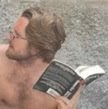
I saw Saint Augustine today, weeping under a fig tree as he watched me thumb through his Confessions on the toilet. In 4th century Hippo, most people probably shat communally as they sat atop stone privies designed to accommodate multiple participants. “Noli spectare. Perturbat me . . .”—this circumstance was perhaps not as convenient for light reading as is our current situation.


So, naturally, I could understand his confusion and disappointment as I skimmed over his conversion experience—the climactic triumph of his spirit over flesh—in such close proximity to excrement, which probably happens to be a good distance from the regenerate soul on the ladder of spiritual ascendance.

I know someone like Whitman wouldn't have minded and, in fact, would have likely welcomed this proximity; however, I had the distinct impression that Augustine was not pleased in the least. So I nodded, gently lay the book aside and began to think about the nature of sacred texts—particularly, whether or not they created or should be reserved for sacred spaces (unlike the one I currently occupied). Perhaps they demanded a more reverent physical and spiritual posture, a more solemn response.

For example, most patristic scholars contend that Augustine intended his Confessions to be read reflectively. He envisioned a connection between meditation, as a spiritual exercise, and reading. Thus, by tracing his own journey of self-discovery, which of course culminates in spiritual conversion, Augustine encouraged his readers to try out his method for themselves—uniting their own souls’ progress with the memory of their physical bodies’ passage through historical time just as he did. As Brian Stock suggests, “The individual life thereby became the setting for the
reenactment of the biblical drama of alienation and return.” It is this speculation of Augustine’s authorial intent that consistently thwarts my attempts to shake the conviction that the bishop of Hippo did not imagine a toilet as the stage upon which my personal passion play, the death of my old self and resurrection of the new, would be reenacted. Ultimately, my disconcertedness emanates from the knowledge that the critical problem of Augustine’s Confessions is the translation of thought into action for both himself and his audience. And as I considered this problem with elbows upon knees, hands supporting head and bare feet pressed to cool linoleum, I couldn’t help but feel that my present action was not the most accurate physical translation of Augustine’s metaphysical message.

Perhaps when the saint gazed into the future to picture me reading his autobiography, I was seated beside a wooden prayer bench in a sunlit reading room as a single beam of light like a dove descended from heaven to anoint a particular passage before my eyes. Surely he did not suppose his most intimate work would be the subject of my powder-room perusal. To clarify, it’s not that I think Augustine is necessarily too stilted or sanctimonious to read on the toilet; it’s just that I don’t want to spoil his expectations. I don’t want to take lightly the ethical demands of his text—a text that is considered by many to be sacred.


This leads me to wonder whether secondary sources pertaining to Augustine are also off limits—perhaps, as long as I just skip over quoted passages? Only, this seems like a slippery slope because, as we all know, I’m not reading a first-hand account to begin with. I’m reading Henry Chadwick’s translation, which is only one translation in a long chain of translations and reinterpretations extending all the way back to the 4th century. And here in lies the problem—every new reading is new translation, meaning it must be the sense of the text that is sacred rather than the words on the page—and the sense seems inescapable.

Initially, I intended to suggest that bathroom reading might be a sort of litmus test for sacred texts—if you feel guilty reading it on the toilet, perhaps it’s sacred. However, for Augustine, all truth is God’s truth—all signs, natural and conventional, point to God. Thus, in the Augustinian semiotic explanation of the creation’s relationship to its creator, the sacred becomes inescapable--even on the toilet.

In light of this revelation, Augustine challenges us to assume vocations of “logobiography”— making it our lives’ objective to demonstrate the manner in which we are written into the text of God’s creation (here is where I begin to see obvious connections to our discussion of virtue-ethics). According to the saint, we should recognize our function as signs and producers of signs that point perpetually beyond our/themselves to the referent who subsumes the system of representation.

Of course, I’m not advocating that we return to a medieval world-view in which every mundane occurrence becomes a “sign” from God—I’m merely attempting to suggest that Christianity’s past and present rootedness in semiotics may be conceived of as a contiguous process. For example, I do not believe Augustine’s conception necessarily negates postmodernism’s notion that meaning is linguistically and thus socially constructed, but might rather suggest that the materials with which society constructs have their immutable origins in an original word. Therefore, while incorporeal conceptions such as love, justice and truth might ultimately originate in the logos, the corporeal and thus temporal and malleable manifestations of these conceptions are contingent upon the imbricated vocabularies we employ to communicate them. As reader-response critics Gerhard Ebeling and Ernst Fuchs suggest, our “language enables the ‘word of God’ to ‘speak.’”

Thus, in the reciprocal relationship between creator and created, the word first spoken by God is incarnated in and perpetuated by the thought and action of humanity. And if—as I suggested in my response to Daniel’s recent post—the divine logos pervades and is perpetuated by manifold discourses, contact and negotiation between multiple and divergent perspectives can be conceived of as an essential element in a process of revelation, which Ricoeur describes as “opening something that is closed, of making manifest something that was hidden.”

Ricoeur’s conception of revelation as process also serves as a reminder of what Augustine refers to as our status viatoris—our perpetual state of being on the way, which provides a valuable caution against attempts to reconcile discordant discourses for the achievement of hegemonic consensus. As Bakhitn asserts, “Christ’s truth is real, but its authority cannot be known as dogma or proposition. Genuine truth always involves more work and more risk than dogma or propositions require of us.”

Friday, June 27, 2008

Moses Deconstructed (Prolegomenon)

The following is an act of outright plagiarism of CUNY professor emeritus of philosophy Edith Wyschogrod and her article, "Eating the Text, Defiling the Hands." The weblogger will move seamlessly in and out of Wyschogrod's text so as to create uncertainty regarding the authorship of ideas, effectively resulting in a boosting of credit in the weblogger's favor and at the expense of Wyschogrod's good name.

Moses descended from Mount Sinai with two stone tablets in hand, and happened upon the scene of the greatest act of blasphemy in human history. The Israelites had given up their finest jewelry for Aaron to melt down and fashion into a golden calf. It was a beautiful calf, the people were pleased, and they said, "These be thy gods, O Israel, which brought thee up out of the land of Egypt." It looked exactly like this:


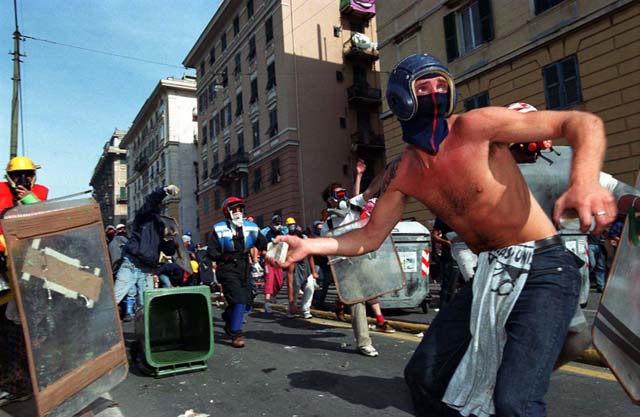
Moses, who, as we all know, wrote the book of Exodus in real time, as it was happening (this is how he managed to write his own epitaph - he wrote it as he was dying), had only to scroll back to Chapter 20, verses 2-3, to perceive that something was awry: "I am the LORD thy God, which have brought thee out of the land of Egypt, out of the house of bondage. Thou shalt have no other gods before me." Moses did an on-the-fly synchronic textual analysis of this commandment and the Israelites' above-quoted pronouncement, and identified the polar opposition between the two. Aaron and the Israelites almost seemed to have gone out of their way to invert the First Commandment word for word. Moses was indignant, and he looked exactly like this:

We tend to have either of two reactions to this. Aaron and the Israelites either had a terrible memory, and simply couldn't remember the First Commandment, or Aaron was a great blasphemer who wanted to Stick It To The Man for making them wait so long in the desert.

Then we read a bit more carefully and see that Aaron was a righteous man, and he evidently had the makings of a good pastor. Right after the erection of the calf, Scripture reads, "And when Aaron saw it, he built an altar before it; and Aaron made proclamation, and said, To morrow is a feast to the LORD." The golden calf was raised up in the name of the Lord. The people, weary of merely hearing of God's promises, needed a concrete way to see and experience their God, who was distant from them. Aaron gave them the calf as a visual and imaginative aid to their conception of YHWH, as a sign of hope that their God was real and would fulfill his covenant with them. While this was a good move pastorally for Aaron, he was out of step theologically: In Egypt the Israelites would have been accustomed to seeing grand idols in the Egyptian gods' honor, so showing the grandness of Israel's God through a golden idol would have, in some sense, legitimized YHWH in their eyes. However, YHWH was the imageless God, the God beyond all materiality and all understanding, and Moses knew this. YHWH could not be contained in any human categories, could not be emulated visually, indeed, could not even be named.

We've all heard this before. But here is where I think it gets interesting. (This is an explicitly theological-philosophical reading, not an attempt to capture the "original intent" of the text, pace trained biblical exegetes.) Moses descended Mount Sinai with the two stone tablets - the Very Word of God - in hand, and suddenly realized he was complicit in their sin. The tablets he carried were in effect authoritative representations of God's own will, God's own intentionality. He understood this, and had to act:

And it came to pass, as soon as he came nigh unto the camp, that he saw the calf, and the dancing: and Moses' anger waxed hot, and he cast the tables out of his hands, and brake them beneath the mount.

Moses and Aaron represent the twin modes of understanding God: Aaron embodies the power of the image, of the phenomenal manifestation of the divine in the physical world; Moses stands for the ideality of God, the law, the words that create understanding of an invisible and unimaginable God. Both men are in the business of bearing and communicating the divine in human categories so that their people may believe. Moses recognized the people's proclivity for idolatry and understood that, if the golden calf had to be dismantled and burned, the tablets must be broken also. The idea of an original set of tablets, an original inscription of God's very words, simply carried too much potential for idolatry. So he smashed them against the rocks and wrote a second copy, so that all would know that the best we can lay claim to is a copy, which is really a copy of a copy.

Which is really a copy of a copy of a copy, right? Moses' breaking of the stones was a symbolic act, the function of which was to underscore the unattainableness of any kind of original foundation that we can confidently seize and claim as our own. Umberto Eco supposedly said somewhere that the universe is like an onion, and an onion is all peel. You peel back layers trying to find a core, but what you get are more layers. We try to peel back the layers of church history to find the "true Christian community" in the primitive church, and then we see that the early church was riddled with problems, and probably didn't have the kind of robust theology we'd like to credit them with. Then we try to peel back layers of Paul's letters to find the manuscripts that contain the best representation of the Apostle's "original intent", and then we realize that he's reflecting on his experience of seeing Christ. So we take it to the gospels. But after enough layer-peeling we realize that it is impossible to access the man of Jesus independent of a shroud of texts - texts layered over texts layered over texts. Matthew and Luke are layered over Mark, Mark's account was layered over Peter's testimony, Peter's testimony is layered with his cultural and historical assumptions (an "archi-text", if you will).

This is not to say that theology is ultimately meaningless since there's no escape from the endless layer-peeling. It is to say, however, that theology is to be found in the layers, in the shifting sands of our finite knowledge. It is the discomfort with layers that results in all our incessant calf-building - materialism, nationalism, humanism, fundamentalism, scientism, individualism, and, the most difficult golden calf to dismantle, our understanding. The orgiastic Israelites at the foot of Mt. Sinai suddenly look much different when we identify ourselves in them. We are uncomfortable with the uncertainty, the wandering in the desert, the waiting for Moses to descend from the mountain and deliver the goods. Moses will arrive, eventually, and when he does we might be disappointed to find that all he carries are broken tablets, tablets that only defer to what is beyond and behind them, that is, the One who is beyond all names.

...

And the LORD passed by before him, and proclaimed, The LORD, The LORD God, merciful and gracious, longsuffering, and abundant in goodness and truth, keeping mercy for thousands, forgiving iniquity and transgression and sin, and that will by no means clear the guilty; visiting the iniquity of the fathers upon the children, and upon the children's children, unto the third and to the fourth generation.

Exodus 34:6-7