Showing posts with label ethics. Show all posts

Saturday, March 21, 2009

Piety Unbroken by Laughter Spills Blood


I just recently read the graphic novel Watchmen and saw the movie. (If gratuitous violence and sex offend you, stick to the book and avoid the movie. Apart from those excesses, the movie is actually a pretty faithful adaptation.) My wife encouraged me to write a blog post on it, which I’m assuming she did because she got tired of hearing me talk about it all the time and wanted me to redirect it to someone else. So this post is in part an effort to be a more considerate spouse.

(No spoilers anticipated.)

Watchmen rules. It's probably one of my all time favorite works of fiction. It’s a super(anti)hero comic book story about what the world would look like if people in real life traipsed around in costumes taking the law into their own hands. The book has a lot to say about politics, philosophy, ethics and psychology, and Alan Moore designed each of the six main characters to represent six different ways of viewing the world. I’d like to address one issue raised by two of those characters: Rorschach and The Comedian.

Philosophically, the two characters are mirror opposites of each other. Rorschach believes in moral absolutes; the world is comprised of clear-cut distinctions between good and evil. His mask, an inkblot pattern that constantly changes shape, seems to symbolize this. Life is black and white, and while the boundaries between right and wrong continuously flow into and displace each other, blacks and whites absolutely never mix into greys. He is willing to operate as an illegal superhero, savagely torture people who have information he needs and kill evildoers in a variety of colorful ways, as long as it means achieving retributive justice in the end.

The Comedian, on the other hand, doesn’t believe in anything. As you can infer from his name, he thinks life is a joke. He is a superhero because it’s fun, he kills innocent people because he can, he sees no existential difference between the just and the unjust, and he’s a devoted crime fighter even though he thinks the efforts of superheroes are futile in effecting any real change.


What’s interesting is how similar they are when it comes to how they live. Both are merciless killers who will go greater lengths than other superheroes in violently suppressing enemies. They don’t get along well with others, but they do have considerable respect for each other. And they’re both sociopaths. This reminds me of the great lesson learned about the alliance between the Nazis and the Soviets in World War II: the extremes of two opposing ideologies end up having more in common with each other than with anyone in the middle. As Bryce is fond of pointing out, the political spectrum looks more like a horseshoe than a straight line.


I’m interested in the relationship between righteousness and laughter. To me they are like opposing forces: righteousness is very serious, heavy matter, and laughter is as light as air. Righteousness should ground laughter with meaning and laughter should teach righteousness to loosen up a bit. But one with out the other is insanity. Rorschach never laughs and The Comedian never uses “ought” language. They are both sociopaths because they each live out unmixed commitments to either righteousness or laughter.

It might seem counterintuitive, but a life of pure piety is deadly. John Caputo says in Against Ethics, “Piety unbroken by laughter spills blood. Excommunication, extermination, execution, exile, exclusion, extra ecclesia nulla salus est [There is no salvation outside the Church]: that is the outcome of pure piety and of preoccupation with saving powers.” (I will proclaim boldly, without caveat, that Against Ethics is the single most satisfying work of philosophy I have ever read.) We tend to forget that the Spanish Inquisition came out of a time of rekindled interest in Catholic spirituality and holiness, and that purifying Europe of foreign, contaminating elements flowed from the same urge to renew Christianity. It was concomitant with a golden age of Spanish spirituality (St. John of the Cross, St. Teresa of Avila). A similar kind of spiritual revival impelled the 12th century Crusaders. So Rorschach’s brutality is not a dismissible symptom of a pathological love of violence—it has its eye on justice itself.

Uninhibited laughter is no less disturbing. The Comedian’s freewheeling, carefree life of hedonistic laughter is the consummate expression of individual autonomy. No kind of external obligation hinders him—his rule of life is auto- (self) nomy (rule) in the strictest sense. Laughter is as light as air, but even the highest mountain can’t stop the wind; it’s frictionless. Balancing his point against purebred piety, Caputo says, “In certain situations free agency should be made to tremble. When agents produce patients, people who suffer, I want to let agency waver in insecurity, to let autonomy and spontaneity and creativity and freedom feel their own murderousness—instead of singing hymns to them”.

I wish there was some account of Jesus laughing in the gospels (I appreciate The Passion of the Christ, if for no other reason than that it showed Jesus making a joke). Even though laughter is not mentioned specifically, I think Jesus’ way of life embodied the right mixture of laughter and piety. He made fun of and publicly embarrassed the Pharisees for taking themselves so seriously, but he also stood in righteous silence before the sardonic laughter of the Roman guards. As for me, most days I can’t decide whether I should put on sackcloth or just laugh. Trying to live out both is a difficult balance to strike. Maybe that’s why there don’t seem to be any good Christian comedians out there.

Sunday, March 8, 2009

Does Love Supplant Justice?

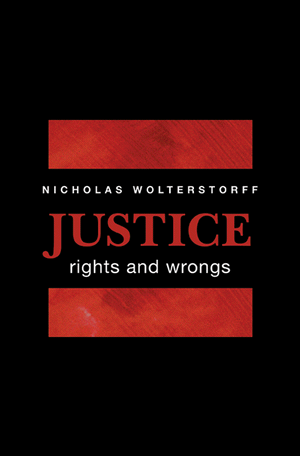
For my birthday I took the liberty of ordering two books that have been bouncing around theology blogs for the past month or so. I started Justice: Rights and Wrongs by Nicholas Wolterstorff, which seeks to ground, to the exclusion of any other narratives, the idea of inherent human rights within theism. I'm struggling through it for several reasons, the main being that I'm not adept enough in his fields of interest to know whether he is pulling a narrative over my head or not. This is not a case of the unreliable narrator but a case of the unreliable reader. I have little knowledge with which to judge his claims so I have to read suspiciously lest I be convinced of ideas that I don't want to, or that I'm not supposed to be convinced of. Ahh the life of a lay-anything feels so unrewarding at times.

(For critics who can offer a more authoritative analysis of the book, check out The Immanent Frame blog)

Regardless, I carry on.

The title question arises from this Wolterstorff analysis:

There has long been a powerful strand of thought in the Christian tradition that de-justicizes the New Testament. The New Testament, so it is said, is about love, not about justice. Justice is the theme of the Old Testament; love, the theme of the New. The Christian puts considerations of justice behind her. Love is her motive and guide. Many non-Christians have gone along and accepted that love supplants justice in the New Testament (96).

Obviously he is going to argue that this should not be the case, and I'm not there in his text yet, but I wanted to proffer the question before I get his answer to explore if we have experienced or assumed this to be true. In thinking on this, I keep coming back to a line President Obama said in his Call to Renewal speech in 2006 that seems to reinforce a similar interpretation of the New Testament. Describing a hypothetical Christian nation, Obama asks which scriptures should guide public policy and ends with this thought: "Or should we just stick to the Sermon on the Mount - a passage that is so radical that it's doubtful that our own Defense Department would survive its application?" Now Obama is not advocating such a move, but his interpretation of the Sermon on the Mount as so radical that any rights or obligations to defend oneself cannot be justified seems to judge the words of Jesus as having little to do with justice and a whole lot to do with the idea of love. Of course the matter is not settled merely by Obama's interpretation of a single passage in the New Testament, but it serves as one example of how I and others view the relationship between love and justice in the New Testament.

My thoughts on this matter have been shaped by the prevalent idea of the Kenotic Christ as example for the Christian and the Church. The well weathered chapter, Philippians 2 serves as the starting point to find the Kenotic Christ:
"5 Let the same mind be in you that was in Christ Jesus, 6 who, though he was in the form of God, did not regard equality with God as something to be exploited, 7 but emptied himself, taking the form of a slave, being born in human likeness. And being found in human form, 8 he humbled himself and became obedient to the point of death-- even death on a cross."
I have always related Kenosis, or self-emptying, to a relinquishment of power. With lit crit as my first introduction to theory, I've often viewed the sum of human relations as a vast network of Foucautian power dynamics. If we are to view Christ as the figure who willingly empties oneself of power, and if that is to be our example, than it does appear that a kenotic love supplants justice. (caveat: I play fast and loose with the scriptures)

This is clearly an idea that we cannot build a legal system on. The early Christians recognized that, and faced with the choice of either going down in a kenotic flame or developing a strategy to somehow instill order and justice, chose the latter and thus the saculem, or secular for all of us who don't read Latin was created. (I'm not quite making this up as I go along. Most of this analysis comes from theology books I didn't make adequate notes on.) Or, as Augustine puts it, there is the City of God and the City of Man. They have different ideas of time and different ideas of justice. If we view the Secular as the time before the eschatological event of Christ's return, than we can develop an idea of worldly justice immune to the radical kenosis of Christ. Which is what we kind of have. Although it makes the example of the kenotic Christ a little tough to apply.

Does that subsume the call of Christ into a form of private pietism while Secular Justice becomes the watchword of all humanity? Or does the New Testament have a lot to say about Justice? I get the feeling that a lot of theologians these days feel like secular logic and justification is in the process of collapsing on itself. There are some, like Rowan Williams who argues that Justice and Human Rights can be adequately grounded without the support of Christianity (listen to his fabulous LSE podcast lecture), but for others like the Radical Orthodox troop and Stanley Hauerwas, Secular understandings of Justice cannot substantiate the worth or rights of a human without eschatology. If I'm not totally off base here, I think they suggest that Christians should start infusing the public square with the kenotic ethic of Christ. What that does to Justice I have no idea, but I take it to mean that Christians should use that ethic as an example and follow it to its logical conclusion by adopting non-violent persuasions and learning how to, not fight for them, but die for them.

I realize I've been a bit too free-wheeling in my attempt to describe how I feel how the idea that love supplants justice might be true, or at least still finds some expressions in current theology. In order to adequately flesh this idea out it is clear that I need to do some work and fill in some holes with references and clearer thought, but after all, this is a blog, and I'm not quite there yet. But I do hope I have described a cogent, if not reputable narrative concerning the demands of justice and love. I do ask those of you who wade in the theological waters more deeply than myself to offer advice and admonishment as needed, especially if I have incorrectly characterized some thinkers/texts.

Friday, July 18, 2008

The Case for Virtue Ethics

After reading over my comment on Nic’s post, I realize that I might be drawing his post into the sphere of my pre-occupation with virtue-ethics without due warrant. That kind of discussion is not very fair to Nic and the work he put into his argument; however, I genuinely believe that virtue-ethics has a place at the table, and my introduction to the topic is probably more a matter of kairos, or poor timing rather than irrelevance (That’s what she said). Let me give it another go, since I’ve already opened my imouth.

Daniel, your remark about the desirability of a middle ground seems apt. I generally lose excitement when the obvious answer to a problem begins to look like something in between to divergent opinions. I’m not sure where to go either, and we will probably have new and different lenses with which to ask the question within the next 20 years or so, so I’m not ready to subscribe to an answer to the whole foundation problem (The fact that I make that statement though, puts me in the layers camp. I still haven’t found out how to get out of my own situatedness). I can’t wait to read what you’ve got on that Eagleton lecture. I loved it and made everyone around me listen to it (much debate in the Doty household).

As a proponent of virtue-ethics, I must briefly touch on the idea of Wisdom, especially as articulated by theologian David F. Ford. First, let me define my terms so as to keep me honest, at least in my own system. When I think of virtue-ethics, I think of the body. I think of material and matter. One of the most hopeful promises I hold for virtue-ethics is that it is, or can be, a great destroyer of abstraction. Directly, it is the branch of ethics that is concerned with the development of practices and forms of living that shape a human life in such a way so that the whole of the human’s life becomes an example of the virtues he/she is striving for. Commitments are grounded in actions, and indeed the very body of the human. There are probably limits to what could constitute a virtue in this sense, but that I take to be a good thing. “Don’t listen to what it says, look at what it does” is a simple phrase that is a good example of what I’m trying to describe. If I claim to care about the plight of HIV victims in Africa, but my behaviors cannot corroborate this claim, then I in fact do not care about such matter. Right, right? Anyone care to critique/expand/narrow my definition thus far?

Wisdom, as I see it, is one of these virtues, which, as people who claim Christianity, should find expressions in our behavior and intellectual practices. Allow me to quote an extended passage from David F. Ford’s Shaping Theology:

[Wisdom] tries to embrace the imaginative, the intellectual, the passionate and the practical; it refers to the wisdom of God as well as to fallible human searching. Wisdom need not be competitive with the various other terms that describe theology, such as understanding, thought, knowledge, truth, reflective practice, dogma and doctrine. Yet it seems to me the most inclusive. While encouraging rigorous inquiry and thorough understanding it is also hospitable to the ethical and the aesthetic. Wisdom traditions are concerned with the long-term shaping of life in many dimensions, including the common good and the formation of the whole person (xvii).

Judging by this description, seeking wisdom is about asking different questions than those that create dichotomies and oppositions. When we seek wisdom, we entertain different consequences than just getting something right or wrong, we take heed of the common good and the consequences to our body and community. A good way to think of wisdom is as an inclusive theological category.
Nic’s post reminded us about the painful inaccessibility of our tradition; although he was quick to show us that our tradition is inaccessible only to those questions and pursuits that try to get it right and try to find an impervious ground to stand on. I introduced virtue-ethics to the conversations because I feel like the development of virtues is an appropriate way to do theology post-foundationalism. And here, more specifically, wisdom as an appropriate theological pursuit in this context, because the search for wisdom takes into account our fallible human searching and seeks to connect our theological pursuits to the way we live and the people and communities we form. That’s my case for virtue-ethics. Keep in mind that these thoughts come from a shameless dilettante, but that doesn’t give me the right to be lazy or make those who know more about this do my work for me. Any thoughts or reactions?

Friday, July 11, 2008

Intersections of Rhetoric and Theology--A Social Ethic of Love

Let me begin by confessing, up front, that I am no theologian. My training is in rhetoric. However, any sweeping survey of rhetorical studies, both ancient and contemporary, would be incomplete without addressing the vast connections between both fields. Rhetoric informs theology and, if you agree with Kenneth Burke, theology informs rhetoric -- they are both mutually dependent (i.e. Burke would argue God is a function of language, so when language dies God dies). For my inaugural post, I thought it would be good, mainly for my sake in being a theological novice, to start with what I'm familiar -- namely, the rhetorical -- and point out one way in which I see the two fields overlapping. And in case you're wondering, I am including a large selection of a recent paper I completed on rhetorical discourse and religious fundamentalism. In this post I will argue that Christian theology offers a rhetorical framework, in God's ethic of love, which dictates the performance of the social. As you read, please view this as jumping off point, and not an all-encompassing, fully thought-out exercise. I simply want to begin the larger pursuit of seeing the intersections of rhetoric and theology (I'd recommend reading Burke's landmark study The Rhetoric of Religion for a more comprehensive analysis)

The Christian story begins with God setting the world in motion, establishing order, and yet also endowing humans with the ability to choose. If order is established by command, such as when God commands Adam to not eat the forbidden fruit (Gen. 2.17), then "the word-using animal not only understands a thou-shalt-not; it can carry the principle of the negative a step further, and answer the thou-shalt-not with a disobedient No" (Burke qtd. in Biesecker 69). With Adam's choice to disobey God's command we see that action contains an ethical element, to act rightly or wrongly, which is made possible by the principle of the negative, or the idea of no. While it may seem, then, that the source of ethics lies in the individual subject, we must remember that Adam's decision not only affects him, but also his relationship to God, to nature, and to Eve. Therefore, God reveals his ethic of love through Christ, who Alan Jacobs reminds us, is "the one identified by the Christian Church as the incarnate love" (9). Christ famously declares, in Matthew 22.37-39: "'Love the Lord your God with all your heart and with all your soul and with all your mind'. . . . And . . . 'Love your neighbor as yourself.'" These two commandments, central to the Christian message, set the standard for the ethical relationship between the self and other that constitute the social.

If language predicates the existence of the social then rhetoric gives us a means of navigating the difference made possible by the principle of the negative, and God's ethic of love limits the possibilities of movement within the paradox of the always and already fractured relationship between "I," "You," and "We." Thus, Burke famously says:

If men [and women] were not apart from one another, there would be no need for the rhetorican to proclaim their unity. If men [and women] were wholly and truly of one substance, absolute communication would be of man's [and woman's] very essence. (qtd. in Biesecker 100).

So we can see, now, that language itself is proof of our incompleteness. Absolute communication, or unity, should never be a goal of an individual or community, because we know it is not possible. But what is possible, and what should be a goal, is the pursuit of love and love in the pursuit of the "other." As Biesecker concludes, "For Burke, that is to say, it is precisely the impossibility of closing the gap between self and other that keeps us engaged with one another, talking to one another, courting one another; that forever keeps us 'promot[ing]' social cohesion by acting rhetorically upon [our]selves and one another'" (100). The principle of the negative may be the motivation that keeps us "acting rhetorically upon ourselves," but God's ethic of love powerfully dictates how we are to act rhetorically. If the central message of the bible, and indeed the central message of Christianity, is the love of God and others, we can see why a Christian might be so well-equipped to engage in discourse that never forecloses difference, and act not only of responsibility but love.

Ultimately, this is why I want to contribute to this communal theology blog--not because I think that I, or any other writer, can reach some determinable end of knowledge or spiritual assent, but because I am spiritually convicted to act rhetorically with/upon others, not to mention the great pleasure I find in the process. So please, feel free to respond, critique, rebuke, or condemn anything you read on this blog. It's all part of the rhetorical process to which we are all committed.