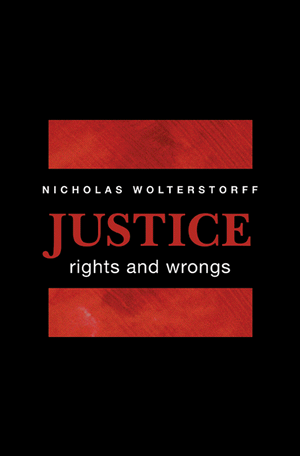
 For my birthday I took the liberty of ordering two books that have been bouncing around theology blogs for the past month or so. I started Justice: Rights and Wrongs by Nicholas Wolterstorff, which seeks to ground, to the exclusion of any other narratives, the idea of inherent human rights within theism. I'm struggling through it for several reasons, the main being that I'm not adept enough in his fields of interest to know whether he is pulling a narrative over my head or not. This is not a case of the unreliable narrator but a case of the unreliable reader. I have little knowledge with which to judge his claims so I have to read suspiciously lest I be convinced of ideas that I don't want to, or that I'm not supposed to be convinced of. Ahh the life of a lay-anything feels so unrewarding at times.
(For critics who can offer a more authoritative analysis of the book, check out The Immanent Frame blog)
Regardless, I carry on.
The title question arises from this Wolterstorff analysis:
There has long been a powerful strand of thought in the Christian tradition that de-justicizes the New Testament. The New Testament, so it is said, is about love, not about justice. Justice is the theme of the Old Testament; love, the theme of the New. The Christian puts considerations of justice behind her. Love is her motive and guide. Many non-Christians have gone along and accepted that love supplants justice in the New Testament (96).
Obviously he is going to argue that this should not be the case, and I'm not there in his text yet, but I wanted to proffer the question before I get his answer to explore if we have experienced or assumed this to be true. In thinking on this, I keep coming back to a line President Obama said in his Call to Renewal speech in 2006 that seems to reinforce a similar interpretation of the New Testament. Describing a hypothetical Christian nation, Obama asks which scriptures should guide public policy and ends with this thought: "Or should we just stick to the Sermon on the Mount - a passage that is so radical that it's doubtful that our own Defense Department would survive its application?" Now Obama is not advocating such a move, but his interpretation of the Sermon on the Mount as so radical that any rights or obligations to defend oneself cannot be justified seems to judge the words of Jesus as having little to do with justice and a whole lot to do with the idea of love. Of course the matter is not settled merely by Obama's interpretation of a single passage in the New Testament, but it serves as one example of how I and others view the relationship between love and justice in the New Testament.
My thoughts on this matter have been shaped by the prevalent idea of the Kenotic Christ as example for the Christian and the Church. The well weathered chapter, Philippians 2 serves as the starting point to find the Kenotic Christ:
"5 Let the same mind be in you that was in Christ Jesus, 6 who, though he was in the form of God, did not regard equality with God as something to be exploited, 7 but emptied himself, taking the form of a slave, being born in human likeness. And being found in human form, 8 he humbled himself and became obedient to the point of death-- even death on a cross."I have always related Kenosis, or self-emptying, to a relinquishment of power. With lit crit as my first introduction to theory, I've often viewed the sum of human relations as a vast network of Foucautian power dynamics. If we are to view Christ as the figure who willingly empties oneself of power, and if that is to be our example, than it does appear that a kenotic love supplants justice. (caveat: I play fast and loose with the scriptures)
This is clearly an idea that we cannot build a legal system on. The early Christians recognized that, and faced with the choice of either going down in a kenotic flame or developing a strategy to somehow instill order and justice, chose the latter and thus the saculem, or secular for all of us who don't read Latin was created. (I'm not quite making this up as I go along. Most of this analysis comes from theology books I didn't make adequate notes on.) Or, as Augustine puts it, there is the City of God and the City of Man.
 They have different ideas of time and different ideas of justice. If we view the Secular as the time before the eschatological event of Christ's return, than we can develop an idea of worldly justice immune to the radical kenosis of Christ. Which is what we kind of have. Although it makes the example of the kenotic Christ a little tough to apply.
Does that subsume the call of Christ into a form of private pietism while Secular Justice becomes the watchword of all humanity? Or does the New Testament have a lot to say about Justice? I get the feeling that a lot of theologians these days feel like secular logic and justification is in the process of collapsing on itself. There are some, like Rowan Williams who argues that Justice and Human Rights can be adequately grounded without the support of Christianity (listen to his fabulous LSE podcast lecture), but for others like the Radical Orthodox troop and Stanley Hauerwas, Secular understandings of Justice cannot substantiate the worth or rights of a human without eschatology. If I'm not totally off base here, I think they suggest that Christians should start infusing the public square with the kenotic ethic of Christ. What that does to Justice I have no idea, but I take it to mean that Christians should use that ethic as an example and follow it to its logical conclusion by adopting non-violent persuasions and learning how to, not fight for them, but die for them.
I realize I've been a bit too free-wheeling in my attempt to describe how I feel how the idea that love supplants justice might be true, or at least still finds some expressions in current theology. In order to adequately flesh this idea out it is clear that I need to do some work and fill in some holes with references and clearer thought, but after all, this is a blog, and I'm not quite there yet. But I do hope I have described a cogent, if not reputable narrative concerning the demands of justice and love. I do ask those of you who wade in the theological waters more deeply than myself to offer advice and admonishment as needed, especially if I have incorrectly characterized some thinkers/texts.