Showing posts with label politics. Show all posts

Sunday, March 8, 2009

Does Love Supplant Justice?

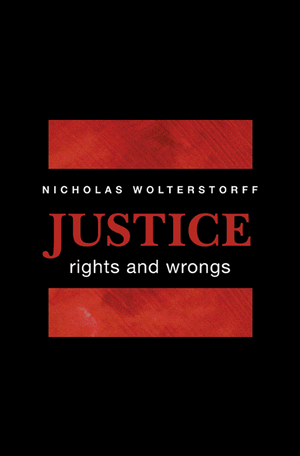
For my birthday I took the liberty of ordering two books that have been bouncing around theology blogs for the past month or so. I started Justice: Rights and Wrongs by Nicholas Wolterstorff, which seeks to ground, to the exclusion of any other narratives, the idea of inherent human rights within theism. I'm struggling through it for several reasons, the main being that I'm not adept enough in his fields of interest to know whether he is pulling a narrative over my head or not. This is not a case of the unreliable narrator but a case of the unreliable reader. I have little knowledge with which to judge his claims so I have to read suspiciously lest I be convinced of ideas that I don't want to, or that I'm not supposed to be convinced of. Ahh the life of a lay-anything feels so unrewarding at times.

(For critics who can offer a more authoritative analysis of the book, check out The Immanent Frame blog)

Regardless, I carry on.

The title question arises from this Wolterstorff analysis:

There has long been a powerful strand of thought in the Christian tradition that de-justicizes the New Testament. The New Testament, so it is said, is about love, not about justice. Justice is the theme of the Old Testament; love, the theme of the New. The Christian puts considerations of justice behind her. Love is her motive and guide. Many non-Christians have gone along and accepted that love supplants justice in the New Testament (96).

Obviously he is going to argue that this should not be the case, and I'm not there in his text yet, but I wanted to proffer the question before I get his answer to explore if we have experienced or assumed this to be true. In thinking on this, I keep coming back to a line President Obama said in his Call to Renewal speech in 2006 that seems to reinforce a similar interpretation of the New Testament. Describing a hypothetical Christian nation, Obama asks which scriptures should guide public policy and ends with this thought: "Or should we just stick to the Sermon on the Mount - a passage that is so radical that it's doubtful that our own Defense Department would survive its application?" Now Obama is not advocating such a move, but his interpretation of the Sermon on the Mount as so radical that any rights or obligations to defend oneself cannot be justified seems to judge the words of Jesus as having little to do with justice and a whole lot to do with the idea of love. Of course the matter is not settled merely by Obama's interpretation of a single passage in the New Testament, but it serves as one example of how I and others view the relationship between love and justice in the New Testament.

My thoughts on this matter have been shaped by the prevalent idea of the Kenotic Christ as example for the Christian and the Church. The well weathered chapter, Philippians 2 serves as the starting point to find the Kenotic Christ:
"5 Let the same mind be in you that was in Christ Jesus, 6 who, though he was in the form of God, did not regard equality with God as something to be exploited, 7 but emptied himself, taking the form of a slave, being born in human likeness. And being found in human form, 8 he humbled himself and became obedient to the point of death-- even death on a cross."
I have always related Kenosis, or self-emptying, to a relinquishment of power. With lit crit as my first introduction to theory, I've often viewed the sum of human relations as a vast network of Foucautian power dynamics. If we are to view Christ as the figure who willingly empties oneself of power, and if that is to be our example, than it does appear that a kenotic love supplants justice. (caveat: I play fast and loose with the scriptures)

This is clearly an idea that we cannot build a legal system on. The early Christians recognized that, and faced with the choice of either going down in a kenotic flame or developing a strategy to somehow instill order and justice, chose the latter and thus the saculem, or secular for all of us who don't read Latin was created. (I'm not quite making this up as I go along. Most of this analysis comes from theology books I didn't make adequate notes on.) Or, as Augustine puts it, there is the City of God and the City of Man. They have different ideas of time and different ideas of justice. If we view the Secular as the time before the eschatological event of Christ's return, than we can develop an idea of worldly justice immune to the radical kenosis of Christ. Which is what we kind of have. Although it makes the example of the kenotic Christ a little tough to apply.

Does that subsume the call of Christ into a form of private pietism while Secular Justice becomes the watchword of all humanity? Or does the New Testament have a lot to say about Justice? I get the feeling that a lot of theologians these days feel like secular logic and justification is in the process of collapsing on itself. There are some, like Rowan Williams who argues that Justice and Human Rights can be adequately grounded without the support of Christianity (listen to his fabulous LSE podcast lecture), but for others like the Radical Orthodox troop and Stanley Hauerwas, Secular understandings of Justice cannot substantiate the worth or rights of a human without eschatology. If I'm not totally off base here, I think they suggest that Christians should start infusing the public square with the kenotic ethic of Christ. What that does to Justice I have no idea, but I take it to mean that Christians should use that ethic as an example and follow it to its logical conclusion by adopting non-violent persuasions and learning how to, not fight for them, but die for them.

I realize I've been a bit too free-wheeling in my attempt to describe how I feel how the idea that love supplants justice might be true, or at least still finds some expressions in current theology. In order to adequately flesh this idea out it is clear that I need to do some work and fill in some holes with references and clearer thought, but after all, this is a blog, and I'm not quite there yet. But I do hope I have described a cogent, if not reputable narrative concerning the demands of justice and love. I do ask those of you who wade in the theological waters more deeply than myself to offer advice and admonishment as needed, especially if I have incorrectly characterized some thinkers/texts.

Tuesday, October 28, 2008

Political Confessions (pt 2 of 4)

I want to thank brother Nic for his honest confession and compelling thoughts in our five-part conversation on politics and religion (has anyone heard of some election coming up soon??). While we’re being confessional here, I should probably go ahead and admit a few things of my own:

Confession #1:
I'm a realclearpolitics.com addict. I literally check the polls and the latest political editorials more often than I do my email theses days. In fact, I've checked the website three times in the process of writing this post. I could really use a support group to help me overcome this addiction! As a Christian, it really is embarrassing how much time I spend consuming the latest political news and ignoring the Christian story. I feel like I have more of a relationship with our presidential candidates than a relationship with Christ. I more publicly tout my identity within a certain political party than the fact that I am a Christian, and I certainly don't do much to live out some of the simplest of Christian acts like loving my neighbors, caring for the poor, etc… so I admit that in any conversation regarding the relationship between politics and religion (limited here to Christianity), it’s a lot easier for me to criticize and critique the political perspectives of certain Christians when I'm basically practicing a pseudo-Christianity. In other words, I feel like a hypocrite in even having this conversation, so I won't be offended if you don't take seriously a word I say…haha

Obviously, there is a tension here between politics and Christianity. In case any of my Rhetoric professors are reading this, I'm speaking of politics in the narrow sense of the operations, including the discourse and actions, of our local and national government and the participation of citizens in that government (in Rhetoric, we say that everything is political). It seems that Christianity is a totalizing system, a rhetorical lens through which to view all existence, and a model of being in this world. I wonder, if I was really living out my Christianity, if it would be possible, or desirable, to set aside my Christianity while participating in and thinking through political issues? Since it appears that Christianity is a system that works best from a position of powerlessness, why not advocate, as Nick hinted at, for complete non-political involvement? Christians didn't enjoy state power until the age of Constantine, so why not return to the pre-Constantinian, early church model?

While its easy to look at our government, that is often lead by self-proclaimed Christian men, and point out its glaring transgressions, hypocrisies, and policies that have anything but Christian effects, I'm not sure that exiting the political arena all together is the best course of action for Christians. I do think we need to reconcile what it means to preach a gospel of brokenness and powerlessness while aspiring to gain power, but more importantly, I think we should take the cue from Jim Wallis and consider a new question: How should religion/faith influence politics?

Confession #2:
I voted in 2004, my first eligible election, for Bush. Ashamedly, back then I never really cared or thought about politics, and I fell prey, like a wildebeest crossing the Masai Mara, to those predatory emails, warning me that the Bush/Kerry election was the most important election in the history of the world. Kerry, then, was the anti-Christ, and if I didn’t vote for Bush it was as good sticking my head inside the croc’s mouth!

It’s amazing how differently one’s perspective can change over four years, and at times I feel like I did stick my head inside the croc's mouth with my vote for Bush. Since '04, I’ve become much more politically informed as a result of seeing the disastrous, real life consequences of failed leadership in our government. Ironically, I’m getting the same emails again this year, but this time Obama is the ant-Christ and McCain is the only real Christian in the campaign. (If, indeed, being Christian means taking pro-life, pro-guns, anti-gay rights, and lower-tax positions)

As I’ve witnessed the voice and influence of the Christian community in this election year I’ve become rather ashamed of the lack of civil discourse exuded by many Christians. Why aren’t Christians the ones openly seeking to create a space where ideas can be rationally debated instead of spreading around false lies, presuming to know who’s Christian and who's not, whose preacher is more theologically sound than another’s, and conflating words they don’t understand (socialist, Marxist, communist) with “evil.” Sadly, the first person I read who made the strongest case for a new civil discourse was Sharon Crowley in Toward a Civil Discourse, and she's certainly no Christian.

Lately, I've been into simplifying things, and Jim Wallis, in The Great Awakening: Reviving Faith & Politics in a Post-Religious Right America, offers up the simple notion that Christians should not seek to control the political arena, but to allow their Christian lens to serve as a moral center to the discussion. Such a moral center should focus on politics of the common good, with emphasis on the very larger issues of fighting poverty, hunger, disease, and environmental conservation. Christians should be motivated to tackle these issues because of their faith, but they can, and should make their arguments in ways that can be accepted by people of any faith or no faith.

In other words, I think Christians should be involved in politics if they can do so realizing that we do not live in a theocracy, we desperately need to find solutions to major problems, and so we should be the leaders in creating a space for civil discourse.

Can anyone say that our political culture is one of love and civility these days?

Confession #3:
While I’m being confessional, I might as well go ahead and tell you that I plan on voting for Obama.

I agree with Nick in that Obama will not be a Christian president if being a Christian president means enacting policies that align with Christianity. I can say that I am voting for him because I believe he would be a step in the right direction towards creating a new discourse of civility and rationality in our political culture. He's demonstrated an ability to work through difficult, controversial issues such as abortion and gay rights in fresh, respectful, thoughtful, non-irritative ways. In this sense, I do sing the praises of his nuance. I also think his civil temperament is exactly what we need in a culture stifled by Left v. Right ideology. I don't presume to know if Obama's Christianity is informing his belief in finding middle ground, but I do know the actions of our political leaders directly affect the lives of not only our own citizens, but people around the world, and so it is vital that our next president be able to create a civil space large issues can be honestly and urgently addressed. I look forward to a president who can be a voice of reason and leadership on key issues that all Christians should be concerned about. I hope that more Christians will become politically involved but in a way that respects the voices of non-Christians.

I know I haven't necessarily made a theologically compelling argument here, but hopefully I've offered a simple idea of how Christians can and should be involved in politics in way that doesn't seek power, but the common good.

Monday, October 27, 2008

Barack Obama Will Not Be a Christian President (Politics Conversation, 1 of 4)

There is something I have been reluctant to confess publicly. I have tried to submit to the generally optimistic mood recently, the optimism concerning the prospect of electing such a dramatically different man from the Current Occupant—and not just a dramatically different man; a dramatically different, Christian man. Many Christian liberals and progressives are feeling the premonitions of a New Day coming, a day when a man will be put in office who understands and can give voice to the Christian concern for poverty, a man who demonstrates spellbinding, riveting philosophical acumen and theological sensitivity when discussing (heretofore) impenetrably difficult issues like homosexuality and abortion (The nuance, O the nuance! How we sing thy praise!), yes, a man who at one point was so impervious to cultural whims about noncommittal displays of patriotism that he even refused to wear a flag pin!

But I fear I cannot submit to this optimism any longer. True, I was even for a time a leader in the front lines of the troops of optimism, that veritable Army of Hope, only six months ago. But I can no longer wave that flag, the flag I waved when I phone banked for the Democrat during the Texas primaries (But Barack Obama could be that Christian President we’ve been praying for!...[click]). My confession is this: I fear Barack Obama will not in fact be a Christian President if he is elected next week.*

This is because the very epithet “Christian President” has already begun to collapse in on itself, even before Mr. Obama arrived on the scene. There are a couple of ways I could describe the incommensurability of the concepts “Christian” and “President”. I could take one route, the one William T. Cavanaugh takes, and trace the genealogy of the modern state back to its genesis in the 17th century as a struggle between an imperialistic, totalizing national State and the other social bodies that stood in its way (feudal hierarchies, trade guilds, the church). The invention of modern “human rights” was a brilliant act of thaumaturgy that guaranteed civilians something they already had under feudal arrangements, and the expanding liberal state sold the idea as a way to undercut the legitimacy of these other social bodies. Perhaps more importantly, the rise of “universal human rights” happened to coincide with the rise of the state’s monopoly on violence—human rights were merely a way for the state to cash in on its own prize to itself. In this line of thinking, the church and the modern state are therefore inherently at odds with one another, and Christians must chose sides, drive their boot heels into the ground and defend the integrity of the church against the state’s unceasing megalomania.

Or perhaps we do not have to go that far; perhaps we do not have to accuse Mr. Obama of being an unwitting actor in an unfolding drama that has already been scripted for him. Maybe we can instead take him at his own word. In a 2006 speech on faith and politics, Mr. Obama described the difficulty of carrying one’s faith commitments and political commitments simultaneously. Whereas politics is the art of the possible, marked by an appreciation for compromise and negotiation, religion is the art of the impossible, he said.

Abraham was righteous precisely because he threw himself at the feet of a call that made absolutely no sense. Jesus calls us to turn the other cheek, even though it is an open invitation for someone to come in and be a tyrant. But how much room is there for the impossible when you have already been sworn into an arena where the “possible” is played, and played exclusively? Is there much elbow room in a Senate packed with lobbyists’ money?

Christians must bear witness to the impossible by living according to radical hospitality and forgiveness in a world that takes victims that are not even hospitable or forgiving. Christians invite thieves into their homes even when their valuables are within easy reach. Christians give away money to causes even when it will empty their bank accounts. Christians do not even shoot back at the man who has just taken the lives of five of their little girls.

So what is so Christian about threatening to invade Pakistan because of reason to believe terrorists are hiding there? What is so Christian about sending billions in military aid instead of humanitarian and development aid to a country already as war-torn as Afghanistan? What is so Christian about throwing immigrants back across the border to countries we have helped keep in perpetual poverty? Is there any room for the impossible to budge—even just a little—in an Oval Office beset on every side by guns, dirty money and the ephemeral tides of populism? It would be nice to think that there is, but one can understand the pessimism of someone like myself who has seen the United States government act one way and one way only in his lifetime. If politicians will not bear witness to the impossible, then are we to leave them to their own devices so we can do a better job ourselves, so that the Amish are not the only ones still concerned with peace? I do not know.

*Do not read this confession as a suggestion that the integrity of Mr. Obama's faith should be doubted or that I will not vote for him. I will, gladly.