Friday, June 4, 2010
An End and a Beginning
I'm not sure if anyone is paying attention to this site, since it's been nearly a year since there's been any activity here, but Corpus Permixtum is no more. In its stead, Bryce and I (Nicolas) have erected a new blog, Circle and Tangent, which can be found here. We hope to see you there.

Wednesday, July 15, 2009
The Conservative Turn...How Did I Get Here?
I'm struggling to remember what it was like to read and contemplate theory. A few years ago I was reading Judith Butler, the Gender Studies maven, as I recall, the conclusions and "unpacking" of gender roles she provided made complete sense in a roundabout way. Now I can't remember why exactly. These thoughts come to me as the General Convention of the Episcopal Church, my, for the time being, intellectual and spiritual preserve, has voted on the liberal side of the sexuality debate. This is partly because the traditionalist have already left the church and have no representation to offer. I guess, as I alluded to in a prior post I was hoping for an eternal stale-mate on this question. I can only assume that my prior life as a professional student would have openly welcomed this decision, but my place and activities have changed from the days of sitting around reading theory. While I don't think I'm necessarily any smarter than those days, I don't think I'm any dumber, or less contemplative about matters either. So the question becomes, how did such a change in thinking occur?
My best approximation: Place determines one's position
The academic environment informs opinion differently than the business world. I'm not thoroughly saturated in the business world, but I didn't want to use a phrase like "real world" as the alternative to the academic environment. I don't think that I have upgraded the milieu in which I live, but I do get different answers than before. So how do we reconcile the different places that we live in and the different prespectives that we garner from our respective places? Absent a universal or public good, how do our competing conceptions of good hold any preference outside of our place?
My father teaches math on the weekends to a group of students who aim to be the first college bound people in their families. He tries to prepare them for success in that environment. Every once in a while a truly talented kid will come through the program. Several years ago one such kid was mentored into applying to Princeton and subsequently received a full ride there. His parents, who did not exist within a framework where going to Princeton is a great achievement could not understand why their kid would need to go all the way to New Jersey, far away from his entire family to go to school when UT Permian Basin was in Odessa. The kid ended up going to UTPB. He could have chosen to go Princeton and followed the narrative of luminaries like Sonia Sotomayor, but he didn't. His place configured success differently than that.
And while we do have the law, which judges narratives as corrupt or not based upon legislation, a gang member might have a fully functioning rational narrative to take someone's life, but society has judged that as an unacceptable narrative, there seems to me few other frameworks with which to judge which narratives are successful and which ones are not.
So in the case of the Episcopalians, we have rival conceptions of Christ's church, informed by differing narratives in which majority rules. This makes me uneasy, I would prefer a framework of doctrine or creeds or authority, of course only when it complies with my perspective, to help adjudicate decisions like these. Even then, such tools are not stable.
It seems all I can do is make the narrative, or the opinions that my place has informed as attractive as possible and try to win as many as possible. A few weeks ago I was comforted by a passage in Thomas Merton's New Seeds of Contemplation in which he advocates a more other peoples conception of the good are none of your business attitude: "the humble man takes whatever there is in the world that helps him to find God and leaves the rest aside." This is all well and good, unless child molestation helps one to find God. It also does nothing to alleviate the anxiety I feel about my own positions. I would prefer to be "Right" within my own opinions, whatever that means, but subscribing to the idea that my opinions are the outcome of my place makes that hard to do.
I'll end with a witty quip by Terry Eagleton. Speaking on the adoption of Scientology and New Age Spirituality by celebrities he has this to say: "you wouldn't believe that if you only had $38.00 in the bank". I think that quote can apply to everything I wrote today.
Saturday, March 21, 2009
Piety Unbroken by Laughter Spills Blood

I just recently read the graphic novel Watchmen and saw the movie. (If gratuitous violence and sex offend you, stick to the book and avoid the movie. Apart from those excesses, the movie is actually a pretty faithful adaptation.) My wife encouraged me to write a blog post on it, which I’m assuming she did because she got tired of hearing me talk about it all the time and wanted me to redirect it to someone else. So this post is in part an effort to be a more considerate spouse.
(No spoilers anticipated.)
Watchmen rules. It's probably one of my all time favorite works of fiction. It’s a super(anti)hero comic book story about what the world would look like if people in real life traipsed around in costumes taking the law into their own hands. The book has a lot to say about politics, philosophy, ethics and psychology, and Alan Moore designed each of the six main characters to represent six different ways of viewing the world. I’d like to address one issue raised by two of those characters: Rorschach and The Comedian.
 Philosophically, the two characters are mirror opposites of each other. Rorschach believes in moral absolutes; the world is comprised of clear-cut distinctions between good and evil. His mask, an inkblot pattern that constantly changes shape, seems to symbolize this. Life is black and white, and while the boundaries between right and wrong continuously flow into and displace each other, blacks and whites absolutely never mix into greys. He is willing to operate as an illegal superhero, savagely torture people who have information he needs and kill evildoers in a variety of colorful ways, as long as it means achieving retributive justice in the end.
The Comedian, on the other hand, doesn’t believe in anything. As you can infer from his name, he thinks life is a joke. He is a superhero because it’s fun, he kills innocent people because he can, he sees no existential difference between the just and the unjust, and he’s a devoted crime fighter even though he thinks the efforts of superheroes are futile in effecting any real change.
What’s interesting is how similar they are when it comes to how they live. Both are merciless killers who will go greater lengths than other superheroes in violently suppressing enemies. They don’t get along well with others, but they do have considerable respect for each other. And they’re both sociopaths. This reminds me of the great lesson learned about the alliance between the Nazis and the Soviets in World War II: the extremes of two opposing ideologies end up having more in common with each other than with anyone in the middle. As Bryce is fond of pointing out, the political spectrum looks more like a horseshoe than a straight line.

I’m interested in the relationship between righteousness and laughter. To me they are like opposing forces: righteousness is very serious, heavy matter, and laughter is as light as air. Righteousness should ground laughter with meaning and laughter should teach righteousness to loosen up a bit. But one with out the other is insanity. Rorschach never laughs and The Comedian never uses “ought” language. They are both sociopaths because they each live out unmixed commitments to either righteousness or laughter.
It might seem counterintuitive, but a life of pure piety is deadly. John Caputo says in Against Ethics, “Piety unbroken by laughter spills blood. Excommunication, extermination, execution, exile, exclusion, extra ecclesia nulla salus est [There is no salvation outside the Church]: that is the outcome of pure piety and of preoccupation with saving powers.” (I will proclaim boldly, without caveat, that Against Ethics is the single most satisfying work of philosophy I have ever read.) We tend to forget that the Spanish Inquisition came out of a time of rekindled interest in Catholic spirituality and holiness, and that purifying Europe of foreign, contaminating elements flowed from the same urge to renew Christianity. It was concomitant with a golden age of Spanish spirituality (St. John of the Cross, St. Teresa of Avila). A similar kind of spiritual revival impelled the 12th century Crusaders. So Rorschach’s brutality is not a dismissible symptom of a pathological love of violence—it has its eye on justice itself.
Uninhibited laughter is no less disturbing. The Comedian’s freewheeling, carefree life of hedonistic laughter is the consummate expression of individual autonomy. No kind of external obligation hinders him—his rule of life is auto- (self) nomy (rule) in the strictest sense. Laughter is as light as air, but even the highest mountain can’t stop the wind; it’s frictionless. Balancing his point against purebred piety, Caputo says, “In certain situations free agency should be made to tremble. When agents produce patients, people who suffer, I want to let agency waver in insecurity, to let autonomy and spontaneity and creativity and freedom feel their own murderousness—instead of singing hymns to them”.
I wish there was some account of Jesus laughing in the gospels (I appreciate The Passion of the Christ, if for no other reason than that it showed Jesus making a joke). Even though laughter is not mentioned specifically, I think Jesus’ way of life embodied the right mixture of laughter and piety. He made fun of and publicly embarrassed the Pharisees for taking themselves so seriously, but he also stood in righteous silence before the sardonic laughter of the Roman guards. As for me, most days I can’t decide whether I should put on sackcloth or just laugh. Trying to live out both is a difficult balance to strike. Maybe that’s why there don’t seem to be any good Christian comedians out there.
Sunday, March 8, 2009
Does Love Supplant Justice?
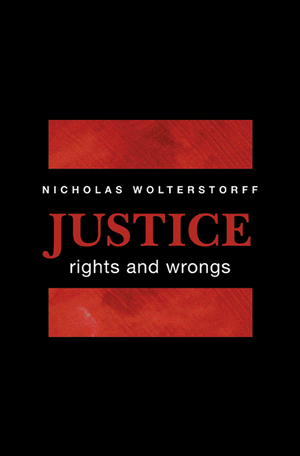 For my birthday I took the liberty of ordering two books that have been bouncing around theology blogs for the past month or so. I started Justice: Rights and Wrongs by Nicholas Wolterstorff, which seeks to ground, to the exclusion of any other narratives, the idea of inherent human rights within theism. I'm struggling through it for several reasons, the main being that I'm not adept enough in his fields of interest to know whether he is pulling a narrative over my head or not. This is not a case of the unreliable narrator but a case of the unreliable reader. I have little knowledge with which to judge his claims so I have to read suspiciously lest I be convinced of ideas that I don't want to, or that I'm not supposed to be convinced of. Ahh the life of a lay-anything feels so unrewarding at times.
(For critics who can offer a more authoritative analysis of the book, check out The Immanent Frame blog)
Regardless, I carry on.
The title question arises from this Wolterstorff analysis:
There has long been a powerful strand of thought in the Christian tradition that de-justicizes the New Testament. The New Testament, so it is said, is about love, not about justice. Justice is the theme of the Old Testament; love, the theme of the New. The Christian puts considerations of justice behind her. Love is her motive and guide. Many non-Christians have gone along and accepted that love supplants justice in the New Testament (96).
Obviously he is going to argue that this should not be the case, and I'm not there in his text yet, but I wanted to proffer the question before I get his answer to explore if we have experienced or assumed this to be true. In thinking on this, I keep coming back to a line President Obama said in his Call to Renewal speech in 2006 that seems to reinforce a similar interpretation of the New Testament. Describing a hypothetical Christian nation, Obama asks which scriptures should guide public policy and ends with this thought: "Or should we just stick to the Sermon on the Mount - a passage that is so radical that it's doubtful that our own Defense Department would survive its application?" Now Obama is not advocating such a move, but his interpretation of the Sermon on the Mount as so radical that any rights or obligations to defend oneself cannot be justified seems to judge the words of Jesus as having little to do with justice and a whole lot to do with the idea of love. Of course the matter is not settled merely by Obama's interpretation of a single passage in the New Testament, but it serves as one example of how I and others view the relationship between love and justice in the New Testament.
My thoughts on this matter have been shaped by the prevalent idea of the Kenotic Christ as example for the Christian and the Church. The well weathered chapter, Philippians 2 serves as the starting point to find the Kenotic Christ:
"5 Let the same mind be in you that was in Christ Jesus, 6 who, though he was in the form of God, did not regard equality with God as something to be exploited, 7 but emptied himself, taking the form of a slave, being born in human likeness. And being found in human form, 8 he humbled himself and became obedient to the point of death-- even death on a cross."I have always related Kenosis, or self-emptying, to a relinquishment of power. With lit crit as my first introduction to theory, I've often viewed the sum of human relations as a vast network of Foucautian power dynamics. If we are to view Christ as the figure who willingly empties oneself of power, and if that is to be our example, than it does appear that a kenotic love supplants justice. (caveat: I play fast and loose with the scriptures)
This is clearly an idea that we cannot build a legal system on. The early Christians recognized that, and faced with the choice of either going down in a kenotic flame or developing a strategy to somehow instill order and justice, chose the latter and thus the saculem, or secular for all of us who don't read Latin was created. (I'm not quite making this up as I go along. Most of this analysis comes from theology books I didn't make adequate notes on.) Or, as Augustine puts it, there is the City of God and the City of Man.
 They have different ideas of time and different ideas of justice. If we view the Secular as the time before the eschatological event of Christ's return, than we can develop an idea of worldly justice immune to the radical kenosis of Christ. Which is what we kind of have. Although it makes the example of the kenotic Christ a little tough to apply.
Does that subsume the call of Christ into a form of private pietism while Secular Justice becomes the watchword of all humanity? Or does the New Testament have a lot to say about Justice? I get the feeling that a lot of theologians these days feel like secular logic and justification is in the process of collapsing on itself. There are some, like Rowan Williams who argues that Justice and Human Rights can be adequately grounded without the support of Christianity (listen to his fabulous LSE podcast lecture), but for others like the Radical Orthodox troop and Stanley Hauerwas, Secular understandings of Justice cannot substantiate the worth or rights of a human without eschatology. If I'm not totally off base here, I think they suggest that Christians should start infusing the public square with the kenotic ethic of Christ. What that does to Justice I have no idea, but I take it to mean that Christians should use that ethic as an example and follow it to its logical conclusion by adopting non-violent persuasions and learning how to, not fight for them, but die for them.
I realize I've been a bit too free-wheeling in my attempt to describe how I feel how the idea that love supplants justice might be true, or at least still finds some expressions in current theology. In order to adequately flesh this idea out it is clear that I need to do some work and fill in some holes with references and clearer thought, but after all, this is a blog, and I'm not quite there yet. But I do hope I have described a cogent, if not reputable narrative concerning the demands of justice and love. I do ask those of you who wade in the theological waters more deeply than myself to offer advice and admonishment as needed, especially if I have incorrectly characterized some thinkers/texts.
Wednesday, March 4, 2009
They'd Advertise--You Know!

A Pact
I make a pact with you, Walt Whitman -
I have detested you long enough.
I come to you as a grown child
Who has had a pig-headed father;
I am old enough now to make friends.
It was you that broke the new wood,
Now is a time for carving.
We have one sap and one root -
Let there be commerce between us.
Ezra Pound
Through the usual channels in which I find interesting things, I came across a blog post from one Brett McCracken entitled: "Are You a Christian Hipster?", a cleverly written piece describing and defining the parameters of just who fits into the category of Christian Hipster.
Here is the prognosis:
Things they don’t like:
Christian hipsters don’t like megachurches, altar calls, and door-to-door evangelism. They don’t really like John Eldredge’s Wild at Heart or youth pastors who talk too much about Braveheart. In general, they tend not to like Mel Gibson and have come to really dislike The Passion for being overly bloody and maybe a little sadistic. They don’t like people like Pat Robertson, who on The 700 Club famously said that America should “take Hugo Chavez out”; and they don’t particularly like The 700 Club either, except to make fun of it. They don’t like evangelical leaders who get too involved in politics, such as James Dobson or Jerry Falwell, who once said of terrorists that America should “blow them all away in the name of the Lord.” They don’t like TBN, PAX, or Joel Osteen. They do have a wry fondness for Benny Hinn, however.
Christian hipsters tend not to like contemporary Christian music (CCM), or Christian films (except ironically), or any non-book item sold at Family Christian Stores. They hate warehouse churches or churches with American flags on stage, or churches with any flag on stage, really. They prefer “Christ follower” to “Christian” and can’t stand the phrases “soul winning” or “non-denominational,” and they could do without weird and awkward evangelistic methods including (but not limited to): sock puppets, ventriloquism, mimes, sign language, “beach evangelism,” and modern dance. Surprisingly, they don’t really have that big of a problem with old school evangelists like Billy Graham and Billy Sunday and kind of love the really wild ones like Aimee Semple McPherson.
Things they like:
Christian hipsters like music, movies, and books that are well-respected by their respective artistic communities—Christian or not. They love books like Resident Aliens by Stanley Hauerwas and Will Willimon, Rich Christians in an Age of Hunger by Ron Sider, God’s Politics by Jim Wallis, and The Imitation of Christ by Thomas a Kempis. They tend to be fans of any number of the following authors: Flannery O’Connor, Walker Percy, Wendell Berry, Thomas Merton, John Howard Yoder, Walter Brueggemann, N.T. Wright, Brennan Manning, Eugene Peterson, Anne Lamott, C.S. Lewis, G.K. Chesterton, Henri Nouwen, Soren Kierkegaard, Pierre Teilhard de Chardin, Annie Dillard, Marilynne Robison, Chuck Klosterman, David Sedaris, or anything ancient and/or philosophically important.
Christian hipsters love thinking and acting Catholic, even if they are thoroughly Protestant. They love the Pope, liturgy, incense, lectio divina, Lent, and timeless phrases like “Thanks be to God” or “Peace of Christ be with you.” They enjoy Eastern Orthodox churches and mysterious iconography, and they love the elaborate cathedrals of Europe (even if they are too museum-like for hipster tastes). Christian hipsters also love taking communion with real Port, and they don’t mind common cups. They love poetry readings, worshipping with candles, and smoking pipes while talking about God. Some of them like smoking a lot of different things.
Christian hipsters love breaking the taboos that used to be taboo for Christians. They love piercings, dressing a little goth, getting lots of tattoos (the Christian Tattoo Association now lists more than 100 member shops), carrying flasks and smoking cloves. A lot of them love skateboarding and surfing, and many of them play in bands. They tend to get jobs working for churches, parachurch organizations, non-profits, or the government. They are, on the whole, a little more sincere and idealistic than their secular hipster counterparts."
I am uncomfortable with such a biting analysis, because a great many of my interests, hobbies, and authors are considered to be things Christian Hipsters like. I don't want to be labeled. Or, I don't want the real me, the me that feels like my pursuits and interests matter to be labeled. But why?
Possible reasons:
1. The "likes" have not been fashioned, attached to my clothing, or put into my iPod for style points, but instead are the sincere results of my desire for there to be "commerce" between Christianity and myself. I think many of those now labeled Christian Hipsters are attempting the noble art of recovering Christianity from the "Pig-headed" version of Christianity best exemplified in the "Things they don't like" category. Whether the experiences of our youth have so stalwartly affixed Christianity to our identity, or whether we are convicted by its story, or whether we are just trying to give the religion a fair shake, we do so with convictions and reasons, having very little to do with the apparent coolness of our texts. Does anybody really read Annie Dillard because she is cool? (Although, judging from the picture I can see why, apart from her excellent talent, why she was published so early in her life.)

I realize I might have hit a snag with reason #1 in that I'm assuming that a label functions as an attempt to explain like interests common among a subset of the population as a product of popularity or group think. I don't think that this is usually the case, but I do think that the post tries to establish the connection.
2. Although the post is clever, it strikes me as engaging in the same type of commentary as shows like South Park. No matter how striking, apt, or well done a piece of social commentary is, if it is not in someway productive or redemptive, I have no use for it. Commentary is easy, theology is hard.
[288]
I'm Nobody! Who are you?
Are you--Nobody--Too?
Then there's a pair of us?
Don't tell! they'd advertise--you know!
How dreary--to be--Somebody!
How public--like a Frog--
To tell one's name--the livelong June--
To an admiring Bog!
-- Emily Dickinson
3. In identifying with what Brett considers a Christian Hipster to be, I realize I have allowed the description of the group to apply too directly to myself. Hawthorne, in "The Blithedale Romance" has a nice short applicable quote:
"It is not, I apprehend, a healthy kind of mental occupation, to devote ourselves too exclusively to the study of individual men and women...if we take the the freedom to put a friend under our microscope, we thereby insulate him from many of his true relations, magnify his peculiarities, inevitably tear him into parts, and, of course patch him very clumsily together again. What wonder, then, should we be frightened by the aspect of a monster, which after all--though we can point to every feature of his deformity in the real personage--may be said to have been created mainly by ourselves!" (69).
There is a sense in which our identities can only be pegged when we are not insulated from our "true relations". We are social creatures. Our religion, race, and style cannot properly define who we are. We are known through our environment of friends and relationships. And while many of the things listed in the post correlate with my identity, they do not describe me. Labels tend to efface the social and relational aspects of identity. The Dickinson poem points to this idea. Although both parties in the poem claim nobody status, we can interpret their claim as a preservation tool from commodification. The admiring Bog will brand you. But what can a Bog know about the livelong June? The answer is that it can't know anything about the livelong June. But it will advertise nonetheless. It will break down the beauty until only a frog remains.
That's why I'm uncomfortable with the Christian Hipster label. I don't know where all of the American Lit came from, I suppose I'll have to proudly wear my P.O.E.M. shirt to bed (Professional Organization of English Majors). I guess I can live with that label.
Tuesday, October 28, 2008
Political Confessions (pt 2 of 4)
 I want to thank brother Nic for his honest confession and compelling thoughts in our five-part conversation on politics and religion (has anyone heard of some election coming up soon??). While we’re being confessional here, I should probably go ahead and admit a few things of my own:
Confession #1:
I'm a realclearpolitics.com addict. I literally check the polls and the latest political editorials more often than I do my email theses days. In fact, I've checked the website three times in the process of writing this post. I could really use a support group to help me overcome this addiction! As a Christian, it really is embarrassing how much time I spend consuming the latest political news and ignoring the Christian story. I feel like I have more of a relationship with our presidential candidates than a relationship with Christ. I more publicly tout my identity within a certain political party than the fact that I am a Christian, and I certainly don't do much to live out some of the simplest of Christian acts like loving my neighbors, caring for the poor, etc… so I admit that in any conversation regarding the relationship between politics and religion (limited here to Christianity), it’s a lot easier for me to criticize and critique the political perspectives of certain Christians when I'm basically practicing a pseudo-Christianity. In other words, I feel like a hypocrite in even having this conversation, so I won't be offended if you don't take seriously a word I say…haha
Obviously, there is a tension here between politics and Christianity. In case any of my Rhetoric professors are reading this, I'm speaking of politics in the narrow sense of the operations, including the discourse and actions, of our local and national government and the participation of citizens in that government (in Rhetoric, we say that everything is political). It seems that Christianity is a totalizing system, a rhetorical lens through which to view all existence, and a model of being in this world. I wonder, if I was really living out my Christianity, if it would be possible, or desirable, to set aside my Christianity while participating in and thinking through political issues? Since it appears that Christianity is a system that works best from a position of powerlessness, why not advocate, as Nick hinted at, for complete non-political involvement? Christians didn't enjoy state power until the age of Constantine, so why not return to the pre-Constantinian, early church model?
While its easy to look at our government, that is often lead by self-proclaimed Christian men, and point out its glaring transgressions, hypocrisies, and policies that have anything but Christian effects, I'm not sure that exiting the political arena all together is the best course of action for Christians. I do think we need to reconcile what it means to preach a gospel of brokenness and powerlessness while aspiring to gain power, but more importantly, I think we should take the cue from Jim Wallis and consider a new question: How should religion/faith influence politics?
Confession #2:
I voted in 2004, my first eligible election, for Bush. Ashamedly, back then I never really cared or thought about politics, and I fell prey, like a wildebeest crossing the Masai Mara, to those predatory emails, warning me that the Bush/Kerry election was the most important election in the history of the world. Kerry, then, was the anti-Christ, and if I didn’t vote for Bush it was as good sticking my head inside the croc’s mouth!
 It’s amazing how differently one’s perspective can change over four years, and at times I feel like I did stick my head inside the croc's mouth with my vote for Bush. Since '04, I’ve become much more politically informed as a result of seeing the disastrous, real life consequences of failed leadership in our government. Ironically, I’m getting the same emails again this year, but this time Obama is the ant-Christ and McCain is the only real Christian in the campaign. (If, indeed, being Christian means taking pro-life, pro-guns, anti-gay rights, and lower-tax positions)
As I’ve witnessed the voice and influence of the Christian community in this election year I’ve become rather ashamed of the lack of civil discourse exuded by many Christians. Why aren’t Christians the ones openly seeking to create a space where ideas can be rationally debated instead of spreading around false lies, presuming to know who’s Christian and who's not, whose preacher is more theologically sound than another’s, and conflating words they don’t understand (socialist, Marxist, communist) with “evil.” Sadly, the first person I read who made the strongest case for a new civil discourse was Sharon Crowley in Toward a Civil Discourse, and she's certainly no Christian.
Lately, I've been into simplifying things, and Jim Wallis, in The Great Awakening: Reviving Faith & Politics in a Post-Religious Right America, offers up the simple notion that Christians should not seek to control the political arena, but to allow their Christian lens to serve as a moral center to the discussion. Such a moral center should focus on politics of the common good, with emphasis on the very larger issues of fighting poverty, hunger, disease, and environmental conservation. Christians should be motivated to tackle these issues because of their faith, but they can, and should make their arguments in ways that can be accepted by people of any faith or no faith.
In other words, I think Christians should be involved in politics if they can do so realizing that we do not live in a theocracy, we desperately need to find solutions to major problems, and so we should be the leaders in creating a space for civil discourse.
Can anyone say that our political culture is one of love and civility these days?
Confession #3:
While I’m being confessional, I might as well go ahead and tell you that I plan on voting for Obama.
 I agree with Nick in that Obama will not be a Christian president if being a Christian president means enacting policies that align with Christianity. I can say that I am voting for him because I believe he would be a step in the right direction towards creating a new discourse of civility and rationality in our political culture. He's demonstrated an ability to work through difficult, controversial issues such as abortion and gay rights in fresh, respectful, thoughtful, non-irritative ways. In this sense, I do sing the praises of his nuance. I also think his civil temperament is exactly what we need in a culture stifled by Left v. Right ideology. I don't presume to know if Obama's Christianity is informing his belief in finding middle ground, but I do know the actions of our political leaders directly affect the lives of not only our own citizens, but people around the world, and so it is vital that our next president be able to create a civil space large issues can be honestly and urgently addressed. I look forward to a president who can be a voice of reason and leadership on key issues that all Christians should be concerned about. I hope that more Christians will become politically involved but in a way that respects the voices of non-Christians.
I know I haven't necessarily made a theologically compelling argument here, but hopefully I've offered a simple idea of how Christians can and should be involved in politics in way that doesn't seek power, but the common good.
Monday, October 27, 2008
Barack Obama Will Not Be a Christian President (Politics Conversation, 1 of 4)
 There is something I have been reluctant to confess publicly. I have tried to submit to the generally optimistic mood recently, the optimism concerning the prospect of electing such a dramatically different man from the Current Occupant—and not just a dramatically different man; a dramatically different, Christian man. Many Christian liberals and progressives are feeling the premonitions of a New Day coming, a day when a man will be put in office who understands and can give voice to the Christian concern for poverty, a man who demonstrates spellbinding, riveting philosophical acumen and theological sensitivity when discussing (heretofore) impenetrably difficult issues like homosexuality and abortion (The nuance, O the nuance! How we sing thy praise!), yes, a man who at one point was so impervious to cultural whims about noncommittal displays of patriotism that he even refused to wear a flag pin!
But I fear I cannot submit to this optimism any longer. True, I was even for a time a leader in the front lines of the troops of optimism, that veritable Army of Hope, only six months ago. But I can no longer wave that flag, the flag I waved when I phone banked for the Democrat during the Texas primaries (But Barack Obama could be that Christian President we’ve been praying for!...[click]). My confession is this: I fear Barack Obama will not in fact be a Christian President if he is elected next week.*
This is because the very epithet “Christian President” has already begun to collapse in on itself, even before Mr. Obama arrived on the scene. There are a couple of ways I could describe the incommensurability of the concepts “Christian” and “President”. I could take one route, the one William T. Cavanaugh takes, and trace the genealogy of the modern state back to its genesis in the 17th century as a struggle between an imperialistic, totalizing national State and the other social bodies that stood in its way (feudal hierarchies, trade guilds, the church). The invention of modern “human rights” was a brilliant act of thaumaturgy that guaranteed civilians something they already had under feudal arrangements, and the expanding liberal state sold the idea as a way to undercut the legitimacy of these other social bodies. Perhaps more importantly, the rise of “universal human rights” happened to coincide with the rise of the state’s monopoly on violence—human rights were merely a way for the state to cash in on its own prize to itself. In this line of thinking, the church and the modern state are therefore inherently at odds with one another, and Christians must chose sides, drive their boot heels into the ground and defend the integrity of the church against the state’s unceasing megalomania.
Or perhaps we do not have to go that far; perhaps we do not have to accuse Mr. Obama of being an unwitting actor in an unfolding drama that has already been scripted for him. Maybe we can instead take him at his own word. In a 2006 speech on faith and politics, Mr. Obama described the difficulty of carrying one’s faith commitments and political commitments simultaneously. Whereas politics is the art of the possible, marked by an appreciation for compromise and negotiation, religion is the art of the impossible, he said.
 Abraham was righteous precisely because he threw himself at the feet of a call that made absolutely no sense. Jesus calls us to turn the other cheek, even though it is an open invitation for someone to come in and be a tyrant. But how much room is there for the impossible when you have already been sworn into an arena where the “possible” is played, and played exclusively? Is there much elbow room in a Senate packed with lobbyists’ money?
Christians must bear witness to the impossible by living according to radical hospitality and forgiveness in a world that takes victims that are not even hospitable or forgiving. Christians invite thieves into their homes even when their valuables are within easy reach. Christians give away money to causes even when it will empty their bank accounts. Christians do not even shoot back at the man who has just taken the lives of five of their little girls.
 So what is so Christian about threatening to invade Pakistan because of reason to believe terrorists are hiding there? What is so Christian about sending billions in military aid instead of humanitarian and development aid to a country already as war-torn as Afghanistan? What is so Christian about throwing immigrants back across the border to countries we have helped keep in perpetual poverty? Is there any room for the impossible to budge—even just a little—in an Oval Office beset on every side by guns, dirty money and the ephemeral tides of populism? It would be nice to think that there is, but one can understand the pessimism of someone like myself who has seen the United States government act one way and one way only in his lifetime. If politicians will not bear witness to the impossible, then are we to leave them to their own devices so we can do a better job ourselves, so that the Amish are not the only ones still concerned with peace? I do not know.
*Do not read this confession as a suggestion that the integrity of Mr. Obama's faith should be doubted or that I will not vote for him. I will, gladly.
Wednesday, October 22, 2008
Poverty and Salvation (A Response and a Lead-In)
 This is in part a response to an astute point made by Matt Duff on one of Bryce’s previous posts, “The Elusive Ecclesiological Jaguar Shark (Church Hunting, pt. 2)” (October 6, 2008), and it is also in part a lead-in to a Church-and-Politics conversation we’ll be starting later on in the week.
Matt raised some valid points on not overemphasizing the importance of caring for the poor as an integral part of the church's mission. I agree that if we flatten the mission of the church to such a degree that all we are is a food bank we forfeit much of the dynamism of what it means to be a spiritual community. (Not to mention we risk failing at trying to do something that food banks are already doing competently.)
Matt, could I press back against your objections just a bit, and try to articulate why I think attentiveness to poverty and suffering is so important? Since this is a complex issue, and one we certainly can't iron out in a single sitting, I’ll limit myself to two points made by one of my favorite theologians, Gustavo Gutiérrez. Gutiérrez, a Peruvian priest regarded as the father of liberation theology, and made a splash in the early 1970s as a theologian trying to make sense of what it meant for the Catholic Church to seek to give its members spiritual nourishment and yet do nothing to resist oppressive Latin American dictatorships that drove Christians into material and spiritual despair. The movement became well known on a popular level in the late 1980s by the film Romero, a true story about a Salvadorian bishop who was assassinated for standing up to his country’s gross violations of human rights. (A superb and convicting film, by the way. I highly recommend it.)
1. "Salvation history is a single history". What Gutiérrez means by this is that there is not a physical, worldly human story and a spiritual, immaterial story, which can be interwoven at times but are essentially distinct. Rather, there is a single story because humans are not merely ghostly souls trapped in material bodies. Human personhood--according to Hebrew thought and increasingly according to recent neuroscience and philosophy of mind--is certainly a multifaceted phenomenon, but not a cleanly bifurcated one. The spiritual is bound up with the material, and vice versa. Jesus came both healing the sick and casting out demons; he came forgiving sins as well as denouncing exploitation by tax collectors. The mission of Christ was to save bodies as well as souls, and in the end we will be raised from the dead in body as well as in spirit. So I suspect that the urge to downplay material nourishment for the sake of more lasting spiritual nourishment might be working from an artificial distinction.
I was in Ghana once with a group of (relatively affluent) American and Ghanaian Christians who went to an abjectly poor village to preach the Gospel. The members of the village had no plumbing or nearby water source, and had to walk a mile to get water from a standing pond that was visibly contaminated. Half of the kids in the village died by the age of five, and half of the kids that did survive had tapeworms. I wanted to ask, Why don't we buy and install a water well for them at the same time that we preach the Gospel? Wouldn't it be better if more children had the sanitation to grow old and have children of their own, so that the church may be larger and more vibrant? Then we could witness to salvation the way Gutiérrez understands it--a salvation that "concerns all men and the whole of man".
I don’t mean to tell that story to unfairly overstate my case. I do think it is important to recognize the integrity of spiritual and material health, however, and if we should be more consistent in Ghana I think we should be more consistent all the way down the line and apply it to our own churches and to how holistically we conceive of salvation.
 2. "The center of the world--so-called because the crucified Jesus dwells there, and with him all who suffer unjustly--is the place from which we must proclaim the risen Lord."
Wanting to be in community with the poor shouldn't be some special treatment we give to one group of people at the expense of another. I agree with Matt that we shouldn't assume that the wealthy don't have needs and privilege the poor out of some disingenuous middle-class guilt. It should go without saying that being wealthy does not preclude a person from a need for spiritual nourishment—when I say suffering I mean suffering of all kinds, including despair, addiction and rejection as well as not being able to afford heating in the winter. This should not be about class warfare and it should not be about base materialism. However, the reason we want to be in community with the poor and suffering is because, like Bryce said, it is a gift. We are better off spiritually when we are nearer to hurt and pain, just as Jesus says, "blessed are the poor" and "blessed are those who mourn". We should be suspicious of the health-and-wealth gospels of the likes of Joel Osteen, which mislead people into thinking that following Jesus is about being happy rather than about taking up our cross. Likewise, we should be weary of church membership that only rounds out our already comfortable lives.
Matt rightly said there is no causation between wealth and righteousness, but it seems to me like Jesus is implying there is causation between poverty and righteousness. He even goes as far as saying it is harder for the rich to enter the Kingdom of Heaven than for a camel to enter the eye of a needle. This is obvious hyperbole, to be sure, but the fact that Jesus gives caution to the extremely rich should at least suggest that there is some causal link between material comfort and spiritual complacence.
I realize I’m setting up a tension here that could easily be interpreted as a contradiction--on one hand I'm saying it's good to hurt, on the other I'm saying we should help those who hurt so they don’t hurt anymore. I think we can live into both sides of this tension in a single motion. We should say to those who suffer, “you are blessed”, while at the same time not letting that be an excuse not to offer a helping hand. We should seek to help the hurting, while at the same time not do so in an effort to “fix them” or to narcissistically recreate them in our own image. As hard as it might seem to do this with integrity, I’m convinced it is what we are call to do, and we have Jesus’ life as an example to follow.
Again, thanks for your comments, Matt, and thanks for stimulating and provoking me into thought. You don’t have to apologize for your lengthy comment, since I’ve obviously overindulged in my own, lengthier response. And feel free to respond with profuse and even lengthier disagreement if you like.
----------
A Concluding Confessional Caveat
I do not purport to be in any fashion an accomplished 'liberation theologian in practice'. As I write this post I become increasingly insecure in articulating this position, as I have few concrete credentials to adjudicate my claim that theology must display a 'preferential option for the poor'. I have, for the most part, enjoyed reading and writing about liberation theology from the comfort of my padded and clean office in small-town America, quite far from the suffering poor of Gutiérrez's Lima or Romero's San Salvador. Do not mistake this position as a kind of attempt to put on airs about authority that I do not in fact have; rather, I build this case from what I understand the Gospel to be that is preached to me and that lays claim to me. So if I have any say left in the matter, I ask that the reader hear me making a confession of what is still before me, mea culpa, mea culpa.A Concluding Confessional Caveat
Monday, October 20, 2008
Betting On a Losing Horse (Church Hunting pt. 3)
 I’ve always been a fan of George Will. It is probably because my Dad reads George Will and the fact that George Will likes baseball and has written an excellent book about it doesn’t hurt either. While I don’t subscribe to his conservative views, I appreciate his perspective and opinion on the broad range of issues he decides to tackle. I genuinely believe that his voice enriches the debate over nation and politics regardless of what he advocates.
His latest editorial, you can find it here, assess the current state of the Episcopalian denomination. It is a good quick read that rings true on many accounts. The Anglican faith in general is imploding on itself because of a number of issues, but of main import is homosexuality. Funnily enough, my faith journey has led me to the Episcopal Church as the starting point in my church hunt. We will see if it is still around by the time I find a church community.
The problem centers around the question of: With whom may we have fellowship? The Episcopal Church (the U.S. branch of Anglicanism) might have jumped the gun a little early and stated that homosexuals may be ordained and married and have fellowship in the Church. It looks like most of the African Anglicans, and now Pittsburgh have answered the question with a resounding no, they may not have fellowship on those terms. Their answer of no, at least for now, bears the implications that all those who condone the Episcopal Church cannot share in their fellowship either. Church divisions, especially ones as massive a scale as this one should not be treated lightly. Katie and I were troubled by a church we had hoped to attend shamedly and a matter of factly stated on its website, “church splits are a dime a dozen”. Surely we can do better than that.
Rowan Williams, the Archbishop of Canterbury, has managed to change the question from “with whom may we have fellowship”, to “how can we best negotiate our differences and still call ourselves the body of Christ?” Unfortunately, the question is slowly being answered outside of such a context. For to locate our differences with doctrine in a context that places emphasis on unity does not resolve any differences at all. I think that is the point. We must learn to live in the buffer between question and answer, at least in the context of a multinational movement. As a body, we must always seek understanding of those that fall on other sides of issues, we must learn how to befriend and take communion with those who differ from us, not in the hope of changing belief or opinion, but to simply keep talking because the Church, as the approximation of the future Kingdom of God can never ultimately become the Kingdom of God. It is out of our purview and scope, and therefore, the barometer for “with whom may we have fellowship with” must be tuned to the virtues and actions that make us Christians and not who we declare may become Christians. Admittedly, that can only take us so far. And on those issues in which, centuries later, the answer has been resolved slowly, we must take heart in the belief, made famous by the Martin Luther King quote that: “The arc of the moral universe is long, But it bends toward justice”. Of course, if that is all that we’ve got, then we are in a very messy state indeed. But the Church is not a democracy; it cannot be governed by an oppressive majority or a progressive minority. It sometimes feels like, no matter if the denomination is Episcopalian or not, membership in a Church is like picking the wrong horse.

I keep going back and forth with these problems, and I don’t seem to be coming to any viable conclusions or even an agreeable state of mind. Have patience with this current attempt to broach a complicated issue, and keep in mind that I am still thinking and praying about these things.
Monday, October 6, 2008
The Elusive Ecclesiological Jaguar Shark (Church Hunting pt. 2)

So how does the belief that the Church is an always approximation of God’s Kingdom, or at best, a “key actor” in the drama of God’s salvation for the world affect which Church we belong to?
For starters, we can flesh out what God’s Kingdom should be up to, and then observe how well the churches we attend create ways to express God’s Kingdom. For me, God’s Kingdom begins with a great deal of localism and ends with everyday life lived in community. I applaud public works and acts of charity, but I don’t think that it is enough to simply give time and resources to the widows and orphans of our society, simply for the fact that they have very real and awkward, most definitely painful gifts to give to me. The poor do not exist so I can assuage the guilt I feel whenever I squander my paycheck and therefore throw some money their way. They exist because life is not fair. We must learn how to love the poor, to know the poor as something more than an ambiguous “the poor”, we must know the poor as the people on our streets. We must learn how to live with the poor and learn how to break bread together and share the all too private information concerning our salaries and jobs, and therefore indebt ourselves one to another. I don’t think that I participate in God’s Kingdom if I don’t have everyday relations with the poor and oppressed. God’s Kingdom is more about loving the poor instead of hating poverty. So what church embodies such a community with the poor?
We live a few blocks away from the crown jewel of Denver’s park system, Washington Park. It is an absolutely gorgeous and stunning huge sprawl of land in the middle of the city. We have the occasion to walk the park most nights, and we can’t help but feel as if it is the best part of the city. It is not in a gated community, but I can safely say that the area around it has become gentrified. A 1500 square foot bungalow in the area easily goes for $650,000 dollars. As much as I want to live in the serenity, whether real or imagined, of the park, I know that the poor do not live there. The churches in the area do good work, but I get the feeling that they contribute, most decently, to the surrounding community, which happens to be families in need of their pet’s being blessed more than anything. Sure there is struggle and strife within this community, there are terrible lives and sadness, but there seems to me to be an absence of the gift of the poor. The temptation to use the church as a community to round out an already happy life is too great there. As much as I am committed to the prospect that Church must be done within one’s immediate surroundings, this place just doesn’t seem to have all the right pieces to do church.
I am challenged by this. I don’t want to commute to church. I don’t want our church to be something we get to “go into” instead of “be a part of” if that makes any sense. As long as the church is missing the vital community of the poor, I fear that it is destined to quibble about worship style and convenience instead of dealing with the real meat of Christian life lived in community. Perhaps churches should subsidize housing in aim of a quota of impoverished or something like that. I don’t know. Maybe I’m not looking hard enough for the poor around me. Or maybe I’m unwilling to move, commute, or subsidize, but all I know is that I need to live and receive the gifts of the poor as much as they need to live and receive the gifts that I can give. The search continues.

Church Hunting pt. 1
 “Church and world are often more prescriptive rather than descriptive terms; in practice, the church is full of the world. This is as it should be; the dialectical drama of sin and salvation implies a dialogical relationship between the church and its others, which include the world and God. Indeed, the Holy Spirit blows where it will, and the activity of the Spirit is not limited to the church. The church is therefore a relational body, and not a closed system. The church is not a polis; ekklesia names something closer to a universal “culture” that is assembled from out of the particular cultures of the world (Healy 2000: 159–75). The church is not only crossed by nonchurch elements; it also contains anti-Christ elements. The church is a corpus permixtum, full of both saints and sinners. As Nicholas Healy reminds us, ecclesiology must maintain both poles of Paul’s dictum in Gal. 6: 14, “far be it from me to glory except in the cross of our Lord Jesus Christ.” On the one hand, we must not boast of the church, as if the church were already the answer to all the world’s social ills; on the other hand, we must glory in Christ, and regard the church as a key actor in the unfolding of the drama of salvation which Christ’s cross has won (Healy 2000: 1–24). The eschatological “not yet” means that the history of the drama so far needs to be told hopefully but penitentially, with room for marginal voices and conflicts. The story is not told in an epic manner, as if the church were made to rule. As the embodiment of God’s politics, the church nevertheless muddles through. God is in charge of all of history. The church’s job is to try to discern in each concrete circumstance how best to embody the politics of the cross in a suffering world” (Cavanaugh “Church” in Blackwell’s Anthology of Political Theology 405).
In Katie and I’s search for a church home, I have kept this passage in mind to help us discern exactly where we should commit our time and resources to. Our search has not been easy, indeed we have to struggle against the temptation of sleeping in and going to the farmer’s market down the street instead of attending churches. I have found that my enthusiasm waxes and wanes in this attempt. When we do decide to go and then we discover how a place doesn’t feel right, or a theology is a little too out of whack for our liking, it seems to set the search back for a week or so. In this post I want to unpack this Cavanaugh passage and help shed some light on just what we are looking for.
I am fascinated and convicted by the thought that the church does not have a monopoly on the workings of the Holy Spirit. I don’t take this idea to necessarily mean The Holy Spirit, but a more general idea of God’s exertion of grace upon our world. I have been guilty of thinking that the Church is the super-structure end all of all ends for the World’s ills before, but I think that ultimately leads to an impoverished community of believers. I still believe that, I think, but the idea needs to be prefaced with the very important “not yet”. As Christians we must struggle with the knowledge that we are paradoxically already transformed into the new creation, while at the same time we are the broken and hapless community in need of much grace and patience. If we are indeed not so hapless, I would think that this whole eschatologic moment would have come a lot sooner. So if the church must negotiate with other voices, and perhaps even contain voices that can carry the whispers of God’s grace in our world, what does that look like? Surely there must be a very bare-bones sub-set of beliefs that one must in some way subscribe to in order to bear the witness of Christian. I don’t like muddled pluralism, but I don’t like rigid sects either. Can the church contain anti-Christ elements? Does the church incorporate the Truth’s of God’s grace outside of it in the same manner as the plundering of Egypt’s riches? Or perhaps the idea that the church is made of the world is very important here. Perhaps subscribing to Christianity is a continual act that can never stick for good. Perhaps there is so much of the world in those who profess the witness of the Church that our subscriptions and memberships are never enough to fully separate ourselves from even the world inside of us. If I interpret that passage as something to be applied personally and inter-church, it can certainly work, although it does sound as if the hope the Church has to offer the world is very muddled indeed.

This reminds me of the idea of Carnival. The saints are always sinners of a sort, and the sinners are always saints of a sort, and in the Carnival revelry, we are exposed as the “already-but-not-yet” hope of for the World. Although we are exposed as the corpus permixtum that we are, our hope is also reified by the act of switching places. When the Kings are made into fools, and the fools into Kings, when the Sinners are made into saints and the saints into sinners, we are reminded, by the sinners who play saints, that we are actually saints of a sort, and we must bear witness as best we can.
Sunday, August 24, 2008
The Way, The Truth, and The Etc. Etc.

Last Wednesday, I visited the local Church of Christ in Sidney, Nebraska. I was out on business, and well, what else is there to do besides play shuffleboard in the local bar? Don’t get me wrong, I love shuffleboard, but had already frequented the “Silver Dollar” the previous night. It was a medium size building, which gave me hope that I could probably make some connections through the ACU network. When I walked into the auditorium, I was greeted by no less than fifteen to seventeen people filling up one aisle of the church. I knew I was taking a risk by attending, and viewing the sparse faces in the crowd confirmed that I had lost my bet with fate, and could not simply pop in and maintain a relative sense of anonymity. After much explaining and easing of fears as to why a young person would grace their assembly, I was soon welcomed into the small life of the church. They wanted me to lead singing, and while, I love to sing the old songs, I have never been graced with a confidence of pitch to actually lead worship. Where’s Daniel Wheeler when you need him?
The irony of the situation is that I have great confidence in my speaking/preaching ability, but judging from the lesson of that night, I could in no good faith offer up words of exhortation, exegesis, or worship that would gel with the firm convictions in Biblical authority and inerrancy, not to mention a wonderful assurance that interpretation of the Bible is straightforward and is not mediated by any whims of culture, intelligence, or history that the Church holds. This realization made me feel like a voyeur, or a PhD candidate in rhetoric studying the “heuristics” of a small time denomination in a small town. I felt more a sense of the sovereignty of the community than a sense of an impoverished theology bent solely on getting to Heaven. Which in turn, made me feel like the typical liberal, forever tolerant and a respecter of persons. To their delight, I told them that I would return next Wednesday night, which I am still planning to do, barring a hankering for shuffleboard. I didn’t want to change them, or explore ways in which, as a community they could broaden their definition of fellowship to include more people than showed up that night. For starters, it is not my community. I don’t feel like it is appropriate to engage in theological discourse where there is a lack of accountability between individuals and communities. To do so would be to come across as foolish as the swindlers (the Prince and Dauphine?) in Huckleberry Finn when they put on mock spiritual revivals. The members of the Church eke out an existence from the ground or at the Cabella’s outdoor headquarters. They solidify their community, not by what they believe, but by simply making the time to show up and be with each other. And although I tell their story in a light that makes Grace abound to all of our foolish human searching, (which reifies my own positions), I do not tell their story in a manner that trivializes what they do when they show up. I do not know where the boundaries of the Church end and begin. I withhold my judgment, at least to their faces, on their quite virulent theology. It just doesn’t seem to be my place to discourse with them.
I tell this story to confess how much our community means to me. Perhaps we are like minded, perhaps we are monolithic in our theology, but I don’t think so. We have diversity, and more importantly, accountability that allows us to engage in discourse. We should never take this for granted, because community is a hard thing to form. I hope we grow together in faith and good works, whatever that means. I hope we build communities with those we see face to face on a regular basis. I hope we are transformed, and I hope we figure this whole thing out, at least for the time being. I’ve started a sermon I want to present the preacher of the Church of Christ in Sidney. When I finish, I’ll post it up here.
Bryce
Friday, August 8, 2008
The Theology of William Young's The Shack

I can’t remember the last time a work of Christian fiction was buzzing on everyone’s lips the way The Shack has been these days (or at least since the Left Behind series). As a testimony to its popularity, I met my grandfather for coffee at a McDonald’s yesterday, and I was reading the book while I waited for him. When he showed up he had the book in hand, and it was only moments before a stranger came to us and asked us where he might get a copy for himself, since he had heard so much about it. So I figured it would be a timely undertaking for this weblog to offer its own humble analysis of the theology that the book espouses.
Possible Spoiler Alert: The editors of the book asked that readers not divulge some key elements of the plot to those who have not read it yet. However, it's nearly impossible to talk about the plot without discussing these.
The story takes place in Portland, Oregon (is this the secret recipe for a book guaranteed to fly off the shelves of Christian bookstores?), where family man Mackenzie Phillips is wrestling with a cloud of depression that descended upon him four years prior, when his six-year-old daughter was brutally murdered by a serial killer during a family camping trip. One day he mysteriously receives an unstamped letter in his mailbox, from God, inviting him to spend the weekend with him in a dilapidated shack in the Oregon wilderness—which happens to be where Mackenzie’s daughter was murdered. When he arrives, he is surprised to find the murder site transformed into an idyllic log cabin with a perfectly manicured lawn, and is greeted by an ethnically colorful personification of the Trinity: God the Father is revealed as a large, jovial black woman—who will surely be played by Queen Latifah when the movie adaptation comes out; Jesus is a 21st century version of himself—an Israeli manual laborer in a token blue jumpsuit; and the Holy Spirit is apparently played by a character from the creepy British children’s show Boobah. What ensues is a weekend of theological conversation and moments of revelation between Mackenzie and each of the three members of the Trinity, wherein God gets a chance to explain him/herself to the troubled, doubting protagonist.
The book’s primary concern is the timeless theological dilemma of the problem of evil: how can an all-loving and all-powerful God allow senseless suffering to run so rampant in the world? In today’s scene of hard Calvinism making such a startling comeback in all kinds of church circles, I found Young’s depiction of God refreshing and hopeful. Young portrays God, not as a puppet master who orchestrates tragedy to show us a lesson about his sovereignty or to create situations that will force us to grow, but as a God who suffers alongside his creation and values relationship with his children above micromanagement.
The difference between Calvinism and Young’s argument is the difference between de facto and de jure understandings of God’s sovereignty. In de facto sovereignty, God is directly behind all activity in the universe—no matter how seemingly insignificant or evil—and every event works in accordance with his will. Whereas de facto refers to what actually is the case, de jure refers to what is “by right” or “by law”; God might not be controlling every detail, but all of creation rightfully belongs to its Creator and awaits the day it will be redeemed back to him/her. To affirm God’s sovereignty, then, is to have faith in God’s ability to redeem the most senseless situations. This is the revelation that ultimately brings healing to Mackenzie.
The Shack also features interesting discussion on the nature of the Trinity. Free-church Protestants in the past have made topics like soteriology (doctrine of salvation) and eschatology (doctrine of the end-times) their main points of focus, while being content to leave more esoteric Trinitarian speculation to Catholics and Orthodox. It's nice to see the topic take a central place in a book so popular the free-church crowd. (Interestingly, the book supports the peculiar doctrine of patripassianism: the historically heretical belief that the Father suffered with the Son on the cross and bears the same wounds.)
For those of you who noticed Eugene Peterson’s blurb on the front cover lauding the book as today’s equivalent of Bunyan’s Pilgrim’s Progress, I wouldn’t go in with such high hopes. While The Shack’s theology can be winning at times, the writing, lamentably, is not. (Will there ever be a return to great Christian fiction, a return to the days when we could claim great writers like Dante and Dostoyevsky? Or is there plenty out there and I just haven’t come across it yet?) The dialogue is quite stilted at times, with characters set up to deliver theological quips seemingly on queue. It’s a bit like watching a 2nd grade Thanksgiving pageant, with students lined up in a row behind the microphone, each taking his turn to uncomfortably say his line and hurry back to his place in the chorus. And the book is more than a little touchy-feely. Everyone refers to God as “Papa”, and Jesus and “Papa” greet each other with a kiss on the lips—and this is after he/she has morphed back from God the Mother into the familiar Father (an old white guy).
As far as the theology goes, the book makes some very important arguments about the nature of God that, I think, are very needed today. Young’s God is pluralistic, relational, non-manipulative, able to experience pain, and at times something of a hippy. We need an injection of this kind of theology in a time when influential people like John Piper are preaching that the 2004 tsunami that claimed a quarter of a million lives was God's way of calling the world to repentance. If what you’re mainly looking for is an inspired work of fiction, however, you might stick with the New York Times Book Review. But then again, my schooling is in theology, not literature, so my expertise is not in this area. Please, let us know what you thought of the book, even if you think I’m totally off.
Friday, July 25, 2008
Sacred Texts on the Toilet
I mentioned in a response to Bryce’s excellent discussion on virtue-ethics last week that it would likely take an entire post to support my claim that Christianity has been, and is, yoked to a world-view grounded in semiotics. As it turns out, I’ve approached the subject in more roundabout manner than I originally intended—I hope the presentation does not detract from the promised explanation.
I saw Saint Augustine today, weeping under a fig tree as he watched me thumb through his Confessions on the toilet. In 4th century Hippo, most people probably shat communally as they sat atop stone privies designed to accommodate multiple participants. “Noli spectare. Perturbat me . . .”—this circumstance was perhaps not as convenient for light reading as is our current situation.

So, naturally, I could understand his confusion and disappointment as I skimmed over his conversion experience—the climactic triumph of his spirit over flesh—in such close proximity to excrement, which probably happens to be a good distance from the regenerate soul on the ladder of spiritual ascendance.
I know someone like Whitman wouldn't have minded and, in fact, would have likely welcomed this proximity; however, I had the distinct impression that Augustine was not pleased in the least. So I nodded, gently lay the book aside and began to think about the nature of sacred texts—particularly, whether or not they created or should be reserved for sacred spaces (unlike the one I currently occupied). Perhaps they demanded a more reverent physical and spiritual posture, a more solemn response.
For example, most patristic scholars contend that Augustine intended his Confessions to be read reflectively. He envisioned a connection between meditation, as a spiritual exercise, and reading. Thus, by tracing his own journey of self-discovery, which of course culminates in spiritual conversion, Augustine encouraged his readers to try out his method for themselves—uniting their own souls’ progress with the memory of their physical bodies’ passage through historical time just as he did. As Brian Stock suggests, “The individual life thereby became the setting for the reenactment of the biblical drama of alienation and return.” It is this speculation of Augustine’s authorial intent that consistently thwarts my attempts to shake the conviction that the bishop of Hippo did not imagine a toilet as the stage upon which my personal passion play, the death of my old self and resurrection of the new, would be reenacted. Ultimately, my disconcertedness emanates from the knowledge that the critical problem of Augustine’s Confessions is the translation of thought into action for both himself and his audience. And as I considered this problem with elbows upon knees, hands supporting head and bare feet pressed to cool linoleum, I couldn’t help but feel that my present action was not the most accurate physical translation of Augustine’s metaphysical message.
Perhaps when the saint gazed into the future to picture me reading his autobiography, I was seated beside a wooden prayer bench in a sunlit reading room as a single beam of light like a dove descended from heaven to anoint a particular passage before my eyes. Surely he did not suppose his most intimate work would be the subject of my powder-room perusal. To clarify, it’s not that I think Augustine is necessarily too stilted or sanctimonious to read on the toilet; it’s just that I don’t want to spoil his expectations. I don’t want to take lightly the ethical demands of his text—a text that is considered by many to be sacred.

This leads me to wonder whether secondary sources pertaining to Augustine are also off limits—perhaps, as long as I just skip over quoted passages? Only, this seems like a slippery slope because, as we all know, I’m not reading a first-hand account to begin with. I’m reading Henry Chadwick’s translation, which is only one translation in a long chain of translations and reinterpretations extending all the way back to the 4th century. And here in lies the problem—every new reading is new translation, meaning it must be the sense of the text that is sacred rather than the words on the page—and the sense seems inescapable.
Initially, I intended to suggest that bathroom reading might be a sort of litmus test for sacred texts—if you feel guilty reading it on the toilet, perhaps it’s sacred. However, for Augustine, all truth is God’s truth—all signs, natural and conventional, point to God. Thus, in the Augustinian semiotic explanation of the creation’s relationship to its creator, the sacred becomes inescapable--even on the toilet.
In light of this revelation, Augustine challenges us to assume vocations of “logobiography”— making it our lives’ objective to demonstrate the manner in which we are written into the text of God’s creation (here is where I begin to see obvious connections to our discussion of virtue-ethics). According to the saint, we should recognize our function as signs and producers of signs that point perpetually beyond our/themselves to the referent who subsumes the system of representation.
Of course, I’m not advocating that we return to a medieval world-view in which every mundane occurrence becomes a “sign” from God—I’m merely attempting to suggest that Christianity’s past and present rootedness in semiotics may be conceived of as a contiguous process. For example, I do not believe Augustine’s conception necessarily negates postmodernism’s notion that meaning is linguistically and thus socially constructed, but might rather suggest that the materials with which society constructs have their immutable origins in an original word. Therefore, while incorporeal conceptions such as love, justice and truth might ultimately originate in the logos, the corporeal and thus temporal and malleable manifestations of these conceptions are contingent upon the imbricated vocabularies we employ to communicate them. As reader-response critics Gerhard Ebeling and Ernst Fuchs suggest, our “language enables the ‘word of God’ to ‘speak.’”
Thus, in the reciprocal relationship between creator and created, the word first spoken by God is incarnated in and perpetuated by the thought and action of humanity. And if—as I suggested in my response to Daniel’s recent post—the divine logos pervades and is perpetuated by manifold discourses, contact and negotiation between multiple and divergent perspectives can be conceived of as an essential element in a process of revelation, which Ricoeur describes as “opening something that is closed, of making manifest something that was hidden.”
Ricoeur’s conception of revelation as process also serves as a reminder of what Augustine refers to as our status viatoris—our perpetual state of being on the way, which provides a valuable caution against attempts to reconcile discordant discourses for the achievement of hegemonic consensus. As Bakhitn asserts, “Christ’s truth is real, but its authority cannot be known as dogma or proposition. Genuine truth always involves more work and more risk than dogma or propositions require of us.”
Friday, July 18, 2008
The Case for Virtue Ethics
After reading over my comment on Nic’s post, I realize that I might be drawing his post into the sphere of my pre-occupation with virtue-ethics without due warrant. That kind of discussion is not very fair to Nic and the work he put into his argument; however, I genuinely believe that virtue-ethics has a place at the table, and my introduction to the topic is probably more a matter of kairos, or poor timing rather than irrelevance (That’s what she said). Let me give it another go, since I’ve already opened my imouth.
Daniel, your remark about the desirability of a middle ground seems apt. I generally lose excitement when the obvious answer to a problem begins to look like something in between to divergent opinions. I’m not sure where to go either, and we will probably have new and different lenses with which to ask the question within the next 20 years or so, so I’m not ready to subscribe to an answer to the whole foundation problem (The fact that I make that statement though, puts me in the layers camp. I still haven’t found out how to get out of my own situatedness). I can’t wait to read what you’ve got on that Eagleton lecture. I loved it and made everyone around me listen to it (much debate in the Doty household).
As a proponent of virtue-ethics, I must briefly touch on the idea of Wisdom, especially as articulated by theologian David F. Ford. First, let me define my terms so as to keep me honest, at least in my own system. When I think of virtue-ethics, I think of the body. I think of material and matter. One of the most hopeful promises I hold for virtue-ethics is that it is, or can be, a great destroyer of abstraction. Directly, it is the branch of ethics that is concerned with the development of practices and forms of living that shape a human life in such a way so that the whole of the human’s life becomes an example of the virtues he/she is striving for. Commitments are grounded in actions, and indeed the very body of the human. There are probably limits to what could constitute a virtue in this sense, but that I take to be a good thing. “Don’t listen to what it says, look at what it does” is a simple phrase that is a good example of what I’m trying to describe. If I claim to care about the plight of HIV victims in Africa, but my behaviors cannot corroborate this claim, then I in fact do not care about such matter. Right, right? Anyone care to critique/expand/narrow my definition thus far?
Wisdom, as I see it, is one of these virtues, which, as people who claim Christianity, should find expressions in our behavior and intellectual practices. Allow me to quote an extended passage from David F. Ford’s Shaping Theology:
[Wisdom] tries to embrace the imaginative, the intellectual, the passionate and the practical; it refers to the wisdom of God as well as to fallible human searching. Wisdom need not be competitive with the various other terms that describe theology, such as understanding, thought, knowledge, truth, reflective practice, dogma and doctrine. Yet it seems to me the most inclusive. While encouraging rigorous inquiry and thorough understanding it is also hospitable to the ethical and the aesthetic. Wisdom traditions are concerned with the long-term shaping of life in many dimensions, including the common good and the formation of the whole person (xvii).
Judging by this description, seeking wisdom is about asking different questions than those that create dichotomies and oppositions. When we seek wisdom, we entertain different consequences than just getting something right or wrong, we take heed of the common good and the consequences to our body and community. A good way to think of wisdom is as an inclusive theological category.
Nic’s post reminded us about the painful inaccessibility of our tradition; although he was quick to show us that our tradition is inaccessible only to those questions and pursuits that try to get it right and try to find an impervious ground to stand on. I introduced virtue-ethics to the conversations because I feel like the development of virtues is an appropriate way to do theology post-foundationalism. And here, more specifically, wisdom as an appropriate theological pursuit in this context, because the search for wisdom takes into account our fallible human searching and seeks to connect our theological pursuits to the way we live and the people and communities we form. That’s my case for virtue-ethics. Keep in mind that these thoughts come from a shameless dilettante, but that doesn’t give me the right to be lazy or make those who know more about this do my work for me. Any thoughts or reactions?
Subscribe to:
Posts (Atom)